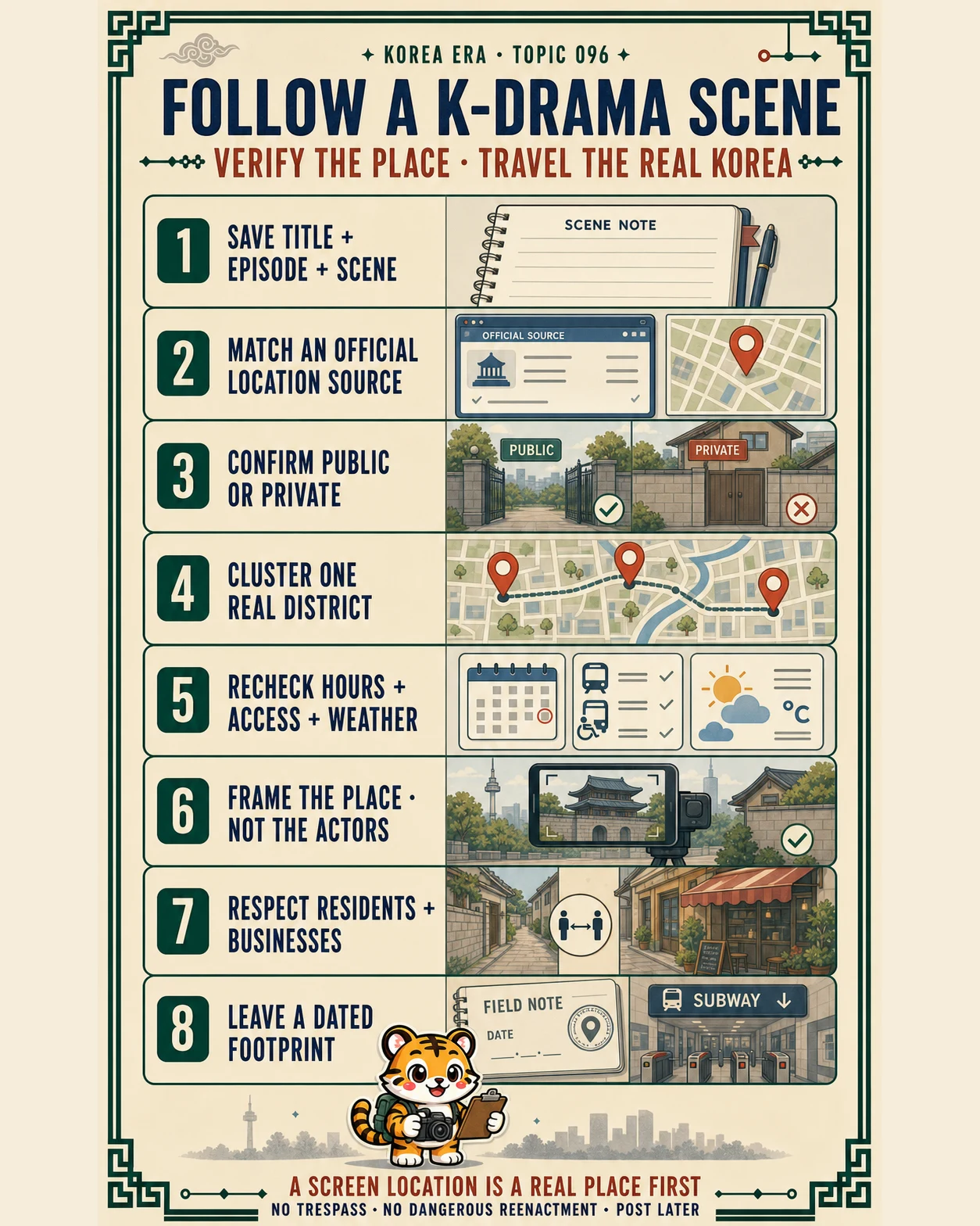
Skip to main content← All guidesAn original eight-step location-verification field card using generic places; it does not reproduce a drama, actor, character, scene, costume or copyrighted frame.Illustration: Korea Era editorial · Korea Era original editorial image
PLANNING · GUIDE
How to follow K-drama filming locations through the real Korea
Save the drama title, episode and scene, match the place through an official tourism or venue source, confirm that it is public, cluster nearby real destinations, recheck live access and photograph the place without trespassing or recreating unsafe action.
A remembered K-drama scene or an undated filming-location post→One verified public place inside a workable real-world district route and complete return
USE IT ON THE TRIP
Keep this guide for the day you need it.
Add it to an itinerary, or ask travelers when one detail may have changed since the last official check.
LAST CHECKEDAugust 22, 202622 days ago. Fares, routes and final train times change—confirm live before you travel.
WHAT TO DO
Follow the trip in order.
Scan the essentials first. Open a step only when you need the detail.
Before you go
1Save the title, episode and sceneWrite the official drama title, season, episode, approximate scene and what is visually distinctive: gate, bridge, wall, skyline, interior, sign or…
Write the official drama title, season, episode, approximate scene and what is visually distinctive: gate, bridge, wall, skyline, interior, sign or landscape. Use a text note rather than reposting a copyrighted frame.
Watch out A show can use a studio set for interiors and a real exterior elsewhere. Similar angles, fan edits and translated titles can identify the wrong place.
2Match an official location sourceLook for a current national, city, provincial or venue page that connects the production to the place, then match the Korean place name and address.
Look for a current national, city, provincial or venue page that connects the production to the place, then match the Korean place name and address. Keep fan blogs only as discovery leads until an operator source confirms the destination.
Watch out An official tourism article can still age. Use its location claim as evidence, then use the current venue page for today's access, fees and conditions.
3Confirm public or privateIdentify the place's real category: public attraction, public street, active business, active school, workplace, private home or managed natural site.
Identify the place's real category: public attraction, public street, active business, active school, workplace, private home or managed natural site. Visit only the area and hours the responsible operator or law makes public.
Look for 관람객 입구 · 사유지 · 출입금지 · 관계자 외 출입금지
Watch out Never enter a courtyard, rooftop, school grounds, private road, hotel area or residential gate because a camera crew once had permission.
After arrival
4Cluster one real districtBuild a three-part day around one verified scene place, one nearby attraction with independent value and one meal or recovery stop.
Build a three-part day around one verified scene place, one nearby attraction with independent value and one meal or recovery stop. Calculate the complete return from the last point before adding another filming location.
Watch out A montage can combine locations across Seoul, another province and a studio. Screen continuity is not travel geography.
5Recheck hours, access and weatherOn the visit date, reopen the operator's hours, final entry, booking, closure, construction, resident restriction, mobility route and photo policy.
On the visit date, reopen the operator's hours, final entry, booking, closure, construction, resident restriction, mobility route and photo policy. Check weather, air quality, daylight, trail or coastal conditions where relevant.
Look for 운영시간 · 입장마감 · 휴관 · 통제 · 우회로
Watch out A public viewpoint can close for weather or safety, and a neighborhood can impose visitor hours. Barriers and live notices override the saved scene.
6Frame the place, not the actorsPhotograph the current architecture, landscape or your own travel object from a legal standing point.
Photograph the current architecture, landscape or your own travel object from a legal standing point. Create an original composition instead of copying a recognizable copyrighted frame, performer pose, dialogue card or soundtrack clip.
Watch out Do not step into traffic, water, cliffs, rails or restricted land to match an angle, and never stage violence, climbing, kissing or stunts that inconvenience or endanger people.
During your trip
7Respect residents and businessesKeep voices low in lived-in lanes, leave doors and tactile paving clear, ask before photographing inside and place a normal order when using an act…
Keep voices low in lived-in lanes, leave doors and tactile paving clear, ask before photographing inside and place a normal order when using an active cafe or restaurant. Accept that decor, ownership and menus change after filming.
Look for 조용히 · 주거지역 · 촬영 금지 · 1인 1주문
Watch out Do not photograph through windows, move furniture, demand a screen-used seat, enter without buying or publish residents, staff and customers without consent.
8Leave a dated FootprintAfter leaving, record the date, Korean place name, public entrance, actual hours observed, fee, access, crowd, photo rule, transport and what futur…
After leaving, record the date, Korean place name, public entrance, actual hours observed, fee, access, crowd, photo rule, transport and what future travelers must recheck. Link the official source and state uncertainty honestly.
Watch out Remove faces, home numbers, school details, receipts, vehicle plates and live location. Do not turn a private or fragile place into a viral pin.
COMPARE OPTIONS
Choose without rereading the page.
Option
Best for
Cost
Watch out
One public attraction with screen history
A palace, museum, park, tower or managed site worth visiting beyond the drama scene.
Current admission and transport · One proper attraction visit
The venue's real visitor route, hours, events and photography rules control the day.
One neighborhood scene cluster
Public streets where the route can include local history, food and an independently useful attraction.
Transit + meal + any chosen business · A half day inside one walkable district
Respect resident zones, visitor hours, private property and business order rules; keep groups small.
One remote landscape location
A coast, mountain, temple or rural site already confirmed as publicly accessible.
Complete two-way transport + weather and closure buffer · A full day or overnight when the return is fragile
Do not copy a scene's weather, cliff, water or road behavior; use live safety and transport information.
Archive-only scene
A demolished set, private home, active school, closed business, unsafe path or unverified location.
No site visit · Research or a nearby public alternative
Mark it unavailable and do not publish directions that invite trespass or resident harassment.
AVOID THESE MISTAKES
6 mistakes worth remembering.
Searching only by character or actor name.
Do this instead Record title, season, episode, scene and a real-place feature before matching sources.
Treating a fan map as access permission.
Do this instead Use it as a lead, then verify the current Korean address and public boundary with the responsible operator.
Following a drama montage as a one-day route.
Do this instead Cluster one district and calculate the last connection before adding another province or city.
Copying the exact scene pose in a road, cliff or residential gate.
Do this instead Make an original safe photograph from a legal public position.
Expecting a business to preserve its filming decor forever.
Do this instead Visit as a current customer, confirm the menu and order rules and accept that the real business changes.
Posting a house or school entrance as a must-visit pin.
Do this instead Remove private and sensitive locations and publish a public alternative with a dated source.
TRAVELER FAQ
Answers before you leave.
How do I confirm a K-drama filming location?
Match the official title, episode and scene to a national, regional, city or venue source, then confirm the Korean name and address. Use the current operator page for access even when the filming claim comes from an older tourism article.
Can I visit a house or school shown in a drama?
Not merely because it appeared on screen. Private homes and active schools are removed unless a responsible current operator provides a clearly public visitor program and entrance.
Can I recreate the exact scene photograph?
Create an original, safe composition from a legal position. Do not reproduce actor likenesses or a recognizable copyrighted frame, and never copy stunts, road behavior, climbing or intimate poses that affect others.
What if the cafe or shop has changed?
Treat it as the current business. Recheck the name, hours, menu, reservation and photo rule, order normally, and do not demand preserved decor or a particular seat.
How many filming locations fit in one day?
Usually one district cluster with one to three nearby public places is more useful than a cross-city list. Calculate the real transport, meal, access and return before deciding.
What should I do when a location is private or closed?
Do not visit or publish a route to the entrance. Keep it as an archive note and choose a public attraction, neighborhood or exhibition with independent travel value.
What makes a useful filming-location review?
Share the date, Korean place name, public entrance, current operator link, actual access, fee, crowd, mobility, photo and return conditions. Remove people, private details and claims beyond your visit.
A foreign visitor's K-pop concert checklist from official ticket sale and identity matching to mobile-ticket access, venue queues, prohibited items, merchandise, crowd safety and the trip home.
A first Korean baseball game from official schedule and team ticket channel to stadium access, seating, food, cheering, rain postponements, safety and the crowded trip home.
A traveler-ready Korean templestay guide covering program choice, official booking, language, shared rooms, early schedules, meals, packing, temple etiquette, accessibility, cancellations and the route home.
Sources & verification10 official sources · August 22, 2026
Check it yourself.
Every changing rule stays attached to the organization responsible for it.
A ten-step arrival workflow that keeps entry decisions, offline essentials, connectivity, payment, airport transport, local transit, accommodation access and help numbers current and usable.
A practical navigation setup for Korea: choosing a local map, searching Korean names, saving road addresses, reading station exits and preparing a taxi-ready address card.
How to choose between station lockers, Seoul T-Luggage storage and same-day delivery, with size checks, operating-hour limits, prohibited items and a safe handoff record.