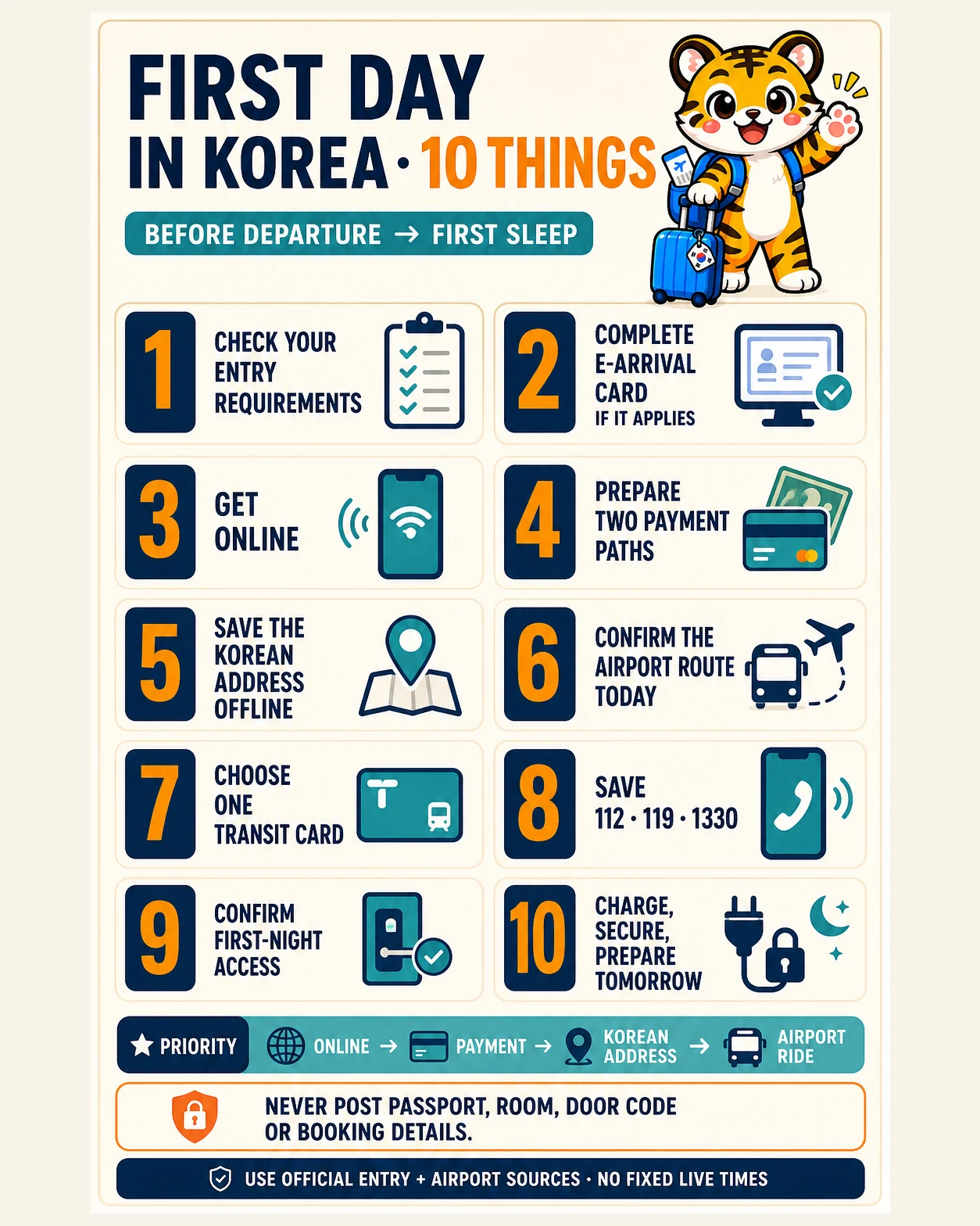
Check passport-based entry rules on official pages, save an offline arrival pack, then compare connectivity, payment, airport transport, transit and first-night access for the exact trip.
Before your flight→Your second day in Korea
USE IT ON THE TRIP
Keep this guide for the day you need it.
Add it to an itinerary, or ask travelers when one detail may have changed since the last official check.
Passport, itinerary and current government navigator
●
Offline arrival pack
Korean address, public route, booking contact and help numbers
+
Payment fallback
Separated card plus a modest KRW option
LAST CHECKEDAugust 24, 202620 days ago. Fares, routes and final train times change—confirm live before you travel.
WHAT TO DO
Follow the trip in order.
Scan the essentials first. Open a step only when you need the detail.
Before you go
1Verify passport-based entry rules on official sourcesUse the official immigration, embassy or K-ETA pages for the exact passport, trip purpose and arrival date.
Use the official immigration, embassy or K-ETA pages for the exact passport, trip purpose and arrival date. Record what applies and the date checked rather than copying another traveler's result.
Watch out Search advertisements and paid application agents can resemble a government page. Start from the official domain and never let a community answer decide entry eligibility.
2Complete only the official arrival declaration that appliesUse the official e-Arrival Card navigator within its current submission window and follow the result for this traveler.
Use the official e-Arrival Card navigator within its current submission window and follow the result for this traveler. Save the official completion record only if the process requires one.
Watch out Do not pay a third party for the free government declaration or assume that a companion's exemption also applies to you.
3Build an offline arrival pack without access secretsSave the Korean accommodation name and road address, public entrance instructions, booking contact, terminal, official transport links and 112, 119…
Save the Korean accommodation name and road address, public entrance instructions, booking contact, terminal, official transport links and 112, 119 and 1330. Keep a copy reachable without a new login or search.
Watch out Keep room numbers, door codes, passport images and booking credentials out of any screenshot you might show, post or send to a public community.
4Choose and test connectivity for the exact deviceCompare roaming, eSIM and physical SIM using the phone's lock status, eSIM support, voice-number need, data allowance, activation timing and provid…
Compare roaming, eSIM and physical SIM using the phone's lock status, eSIM support, voice-number need, data allowance, activation timing and provider support. Save the activation instructions offline.
Watch out No connection type is universally fastest, easiest or cheapest. Do not delete a working home SIM profile or trigger activation earlier than the provider instructs.
After arrival
5Prepare separate payment methods and a KRW fallbackKeep a backup card separate from the main wallet and prepare a modest Korean-won fallback for a first transfer or meal.
Keep a backup card separate from the main wallet and prepare a modest Korean-won fallback for a first transfer or meal. Check any travel notice, cash-withdrawal rule and card lock before departure.
Watch out A card that works at a shop may not work for every ticket or stored-value reload. Confirm the KRW amount and decline an unwanted home-currency conversion before authorizing payment.
6Compare the complete airport route with live serviceCompare AREX, the current airport-bus route and a designated taxi from the arriving terminal through transfers, luggage handling, elevators, final…
Compare AREX, the current airport-bus route and a designated taxi from the arriving terminal through transfers, luggage handling, elevators, final walk and first-night check-in cutoff. Recheck the official fare and departure before paying.
Look for AREX · Airport Railroad · Bus · Taxi · Transportation Center
Watch out A fixed article time is not a last-train promise. Protect every transfer and keep the airport's current late-night bus or designated-taxi fallback until the accommodation entrance is confirmed.
7Choose and fund a transit product for the real routesUse pay-as-you-go transit or compare a time pass only after checking the actual city, lines, airport legs and travel days.
Use pay-as-you-go transit or compare a time pass only after checking the actual city, lines, airport legs and travel days. Confirm the current seller, purchase method, reload method, service area and refund terms for that product.
Watch out Do not buy overlapping products because both appear in a checklist. Airport and regional legs may sit outside a city pass even when ordinary city travel is covered.
During your trip
8Save the right help channel before it is neededSave 112 for police, 119 for fire and ambulance, and 1330 for non-emergency tourism information and interpretation.
Save 112 for police, 119 for fire and ambulance, and 1330 for non-emergency tourism information and interpretation. Also keep the accommodation and transport operator's official contact.
Watch out For immediate danger, crime in progress, fire or medical emergency, call 112 or 119 rather than waiting for a travel helpline or community reply.
9Confirm first-night access before leaving the airportCheck the staffed check-in deadline, late-arrival instructions and the complete route from the final stop to the entrance.
Check the staffed check-in deadline, late-arrival instructions and the complete route from the final stop to the entrance. Keep the Korean address available offline.
Watch out Do not post a room number, door code, booking code or live accommodation pin when asking for directions.
10Close the first day and prepare the next morningCharge your phone and power bank, secure your passport and backup payment separately, save tomorrow's first public destination and get enough sleep…
Charge your phone and power bank, secure your passport and backup payment separately, save tomorrow's first public destination and get enough sleep before expanding the itinerary.
Watch out A delayed arrival is a reason to shorten the next morning, not to compress every missed stop into the first night.
COMPARE OPTIONS
Choose without rereading the page.
Option
Best for
Cost
Watch out
eSIM installed before departure
An unlocked, compatible device whose existing SIM setup is understood.
Current provider quote and data allowance · Provider-specific installation and activation
Confirm device support, voice-number needs and the provider's activation timing before changing profiles.
Physical SIM at the airport
A compatible unlocked device when staffed setup or a Korean number is useful.
Current seller plan and allowance · Current counter hours, queue and activation
Confirm the seller, plan, device lock and identity requirements before removing the existing SIM.
Carrier roaming
Keeping the existing number or avoiding a SIM change when the quoted plan fits the trip.
Current home-carrier quote and roaming terms · Carrier-specific activation and network availability
Confirm activation, daily caps, fair-use limits, voice charges and how to stop unintended roaming.
ILLUSTRATED GUIDES
See it step by step.
The same journeys drawn panel by panel, so you know what the next few minutes look like before you are standing in them.
Depending on a connection before saving the arrival essentials.
Do this instead Keep the Korean address, public entrance, booking contact, terminal, official route and help numbers available offline first.
Using a paid site that looks like the official K-ETA portal.
Do this instead Go to the official government portal directly. Copycat sites charge for a free or cheaper government service.
Following one rigid airport order for every traveler.
Do this instead Secure the next safe step with either a tested connection or the offline pack, then adapt payment, transport and transit choices to the actual terminal and route.
Buying overlapping transit products before checking the routes.
Do this instead Check the cities, lines, airport legs and travel days first, then buy and fund only the product that covers those trips.
Sharing the entire accommodation record to ask for directions.
Do this instead Share only a public place name, road address or nearby entrance. Hide room numbers, door codes, booking credentials and live private pins.
TRAVELER FAQ
Answers before you leave.
Do I need a visa or a K-ETA?
It depends on your passport, and the rules change. Check the official K-ETA portal against your own nationality. No third party can confirm your eligibility.
Is the e-Arrival Card mandatory?
It depends on the traveler's current status. Use the free official form's navigator within its stated submission window and follow that result rather than a third-party summary.
Which map app should I install?
The Seoul Metropolitan Government recommends Naver Map or Kakao Map for routes and live bus information.
What number do I call if something goes wrong?
112 for police, 119 for fire and ambulance, and 1330 for the Korea Tourism Organization travel helpline, which provides information and interpretation.
How much cash should I bring?
Enough to cover a transit card purchase and a first meal. This guide does not recommend an amount, because the answer depends on your trip. The point is not to arrive with zero.
A practical lodging workflow for Korea covering booking evidence, Korean addresses, late check-in, deposits, room inspection, cancellation disputes and tourist help.
Sources & verification8 official sources · August 24, 2026
Check it yourself.
Every changing rule stays attached to the organization responsible for it.
An eight-step Incheon arrival workflow that compares AREX, airport buses and designated taxis without freezing fares or timetables that can change before the traveler lands.
How to get connected in Korea without losing your home SIM: device checks, eSIM activation, airport carrier counters, data-only plans, Korean phone numbers and a safe first-hour setup.
A nationality-safe entry workflow for Korea in 2026: official eligibility checks, the temporary K-ETA exemption, the free e-Arrival Card window and the details to prepare before submission.