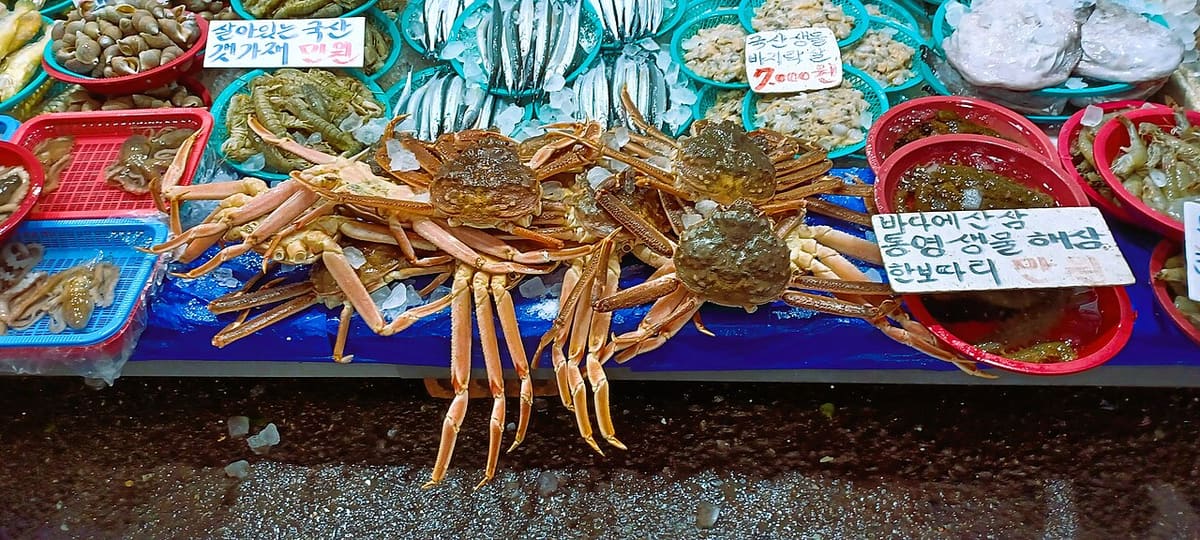
Shopping and eating at a Korean traditional market
Check the exact market and stall hours, carry a small cash backup, confirm the price and portion before ordering, eat only in the designated place, and treat every stall as an independent business with its own payment, allergy and packaging rules.
The entrance to a Korean traditional market→A paid meal or purchase with a clear return route and no assumptions about individual stalls
USE IT ON THE TRIP
Keep this guide for the day you need it.
Add it to an itinerary, or ask travelers when one detail may have changed since the last official check.
LAST CHECKEDAugust 22, 202622 days ago. Fares, routes and final train times change—confirm live before you travel.
WHAT TO DO
Follow the trip in order.
Scan the essentials first. Open a step only when you need the detail.
Before ordering
1Verify the market and the stall separatelyCheck the market's official page or current tourism listing, then the exact vendor if it is the reason for your visit.
Check the market's official page or current tourism listing, then the exact vendor if it is the reason for your visit. Note regular closing days, night-market dates, last order and the route back to your station or bus.
Watch out A market gate being open does not mean every aisle, food program or famous stall is operating.
2Walk one pass before joining the longest queueIdentify food, produce, household-goods and seating areas, compare displayed portions and decide where you can eat.
Identify food, produce, household-goods and seating areas, compare displayed portions and decide where you can eat. Keep entrances, delivery routes and narrow aisles clear.
Look for Entrance 입구 · Food 음식 · Customer center 고객센터 · Restroom 화장실
3Confirm the item, portion and total pricePoint to the exact item and quantity, repeat the total before preparation and ask whether the price is per piece, plate, weight or portion.
Point to the exact item and quantity, repeat the total before preparation and ask whether the price is per piece, plate, weight or portion. Use a calculator screen when spoken numbers are unclear.
Look for Price 가격 · One serving 1인분 · Per piece 개당 · Per 100 g 100g당
At the table
4Ask about ingredients before the food is preparedShow a Korean allergy or dietary card and ask about sauces, stock, frying oil and shared equipment.
Show a Korean allergy or dietary card and ask about sauces, stock, frying oil and shared equipment. Choose sealed labelled food or another vendor when the answer is uncertain.
Watch out A busy vendor may not be able to guarantee cross-contact even when the main ingredient seems suitable.
5Confirm payment before accepting the itemAsk whether an international card works and keep a small amount of Korean won.
Ask whether an international card works and keep a small amount of Korean won. Pay only the agreed total and retain a receipt when one is available, especially for packaged or higher-value goods.
Look for Card 카드 · Cash 현금 · Receipt 영수증
If plans change
6Use the correct eating and waste areaAsk whether the stall has seats, a shared dining area or takeout only.
Ask whether the stall has seats, a shared dining area or takeout only. Return reusable dishes to the vendor and follow local bins for liquids, food waste, recycling and general waste.
7Pack purchases for the rest of the tripAsk whether food needs refrigeration, can leak or has transport restrictions.
Ask whether food needs refrigeration, can leak or has transport restrictions. Put strong-smelling or wet items in secondary packaging and do not assume fresh food can enter another country.
COMPARE OPTIONS
Choose without rereading the page.
Option
Best for
Cost
Watch out
Daytime traditional market
Produce, prepared food and seeing the full working market.
Vendor prices · About 1–2 hours
Individual stall holidays and lunch preparation times differ.
Official night market
Concentrated street-food stalls and evening atmosphere.
Vendor prices · Published event hours
Night markets can be seasonal, weather-dependent or limited to selected days.
Guided market food tour
Ingredient explanation, ordering support and a planned tasting route.
Published tour price · Reserved session
Confirm included tastings, dietary support, cancellation terms and whether the operator is authorized.
AVOID THESE MISTAKES
5 mistakes worth remembering.
Assuming every stall follows the market's headline hours.
Do this instead Verify the exact vendor and keep two nearby alternatives.
Ordering without confirming whether the price is per piece, weight or serving.
Do this instead Point to the item and quantity and repeat the total before preparation.
Using another vendor's table because it appears shared.
Do this instead Ask where your purchase may be eaten and return dishes to the correct stall.
Expecting card payment because another stall accepted it.
Do this instead Confirm payment at each independent vendor and keep a small cash backup.
Carrying fresh or leaking food through a full sightseeing day.
Do this instead Ask about storage, obtain suitable packing and buy temperature-sensitive goods near the end.
TRAVELER FAQ
Answers before you leave.
Can I use an international card at a traditional market?
Often, but not at every stall. Participating tourism markets are improving card acceptance, while official shopping guidance still recommends petty cash for some traditional-market and street vendors.
Should I bargain?
Do not assume bargaining is expected. Use the displayed or quoted price; ask politely about a bundle only before the vendor starts preparing or packing the order.
Can I eat while walking?
Follow that market's layout. Narrow working aisles are safer when you stop at the vendor's table or a designated shared eating area.
How can I handle a food allergy?
Show a Korean allergy card before ordering and ask about sauces, stock, oil and shared equipment. If the vendor cannot confirm, choose a sealed labelled product or another meal.
Are market foods tax refundable?
Do not assume so. Food for immediate consumption and purchases from a non-participating vendor may not qualify. Use the certified sign and current official tax-refund rules.
Can I bring market food home internationally?
Destination-country customs and quarantine rules decide that. Check the official rules before buying meat, fresh produce, seafood or other restricted goods.
A safety-first food workflow for allergies, vegetarian, vegan, halal and other dietary needs, covering Korean labels, hidden stocks, cross-contact and emergency escalation.
A practical first visit to a Korean convenience store: choosing food, reading labels, heating a meal, handling waste, buying or reloading Tmoney and checking which services that exact branch provides.
A practical Korean traditional-liquor class guide covering makgeolli and other formats, reservation and language, age and tasting, rice and nuruk allergens, sanitation, fermentation, pressure, storage, transport, customs and a dated brewery footprint.