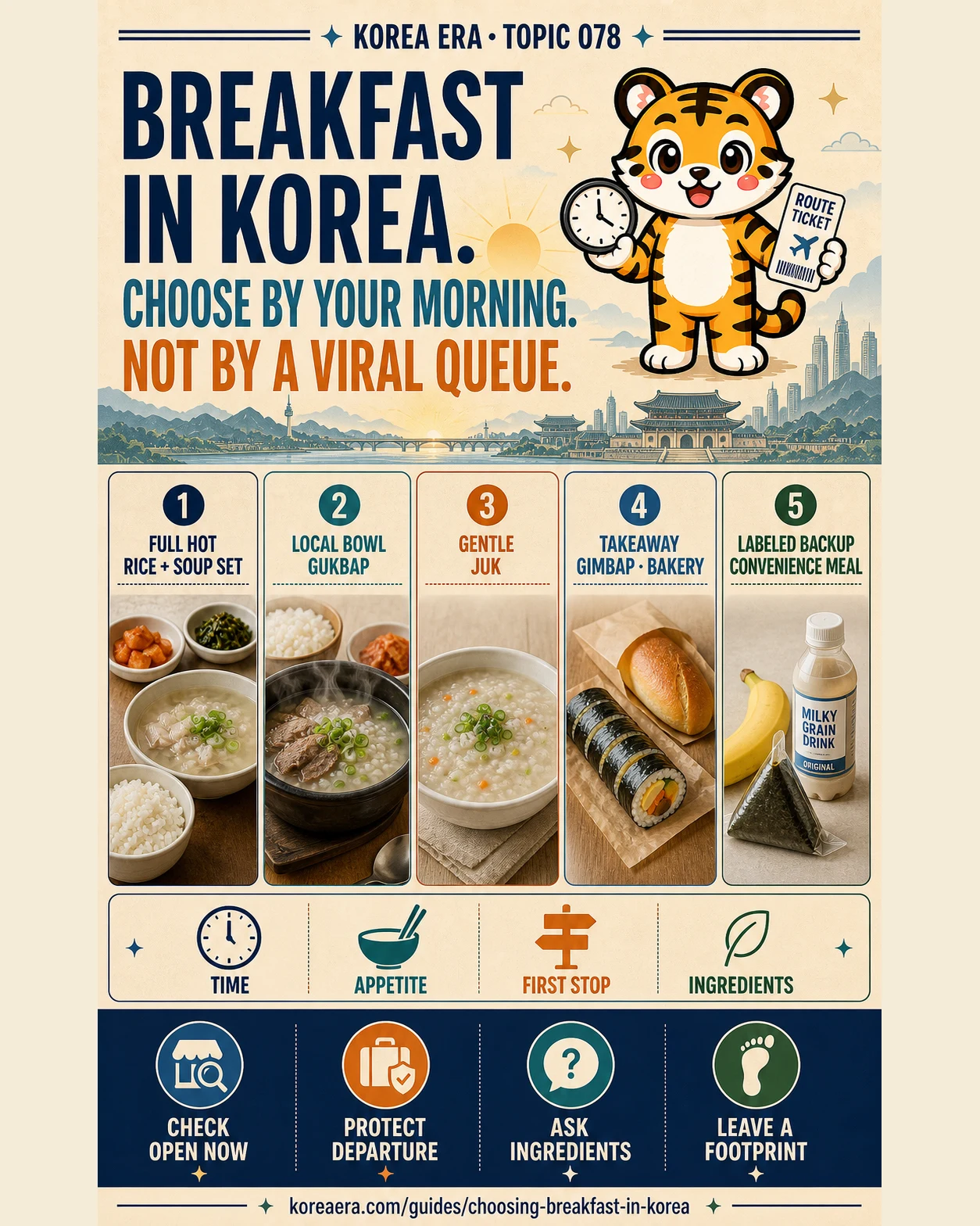
Skip to main content← All guidesAn original route-first breakfast chooser; the five meals are alternatives and do not promise current hours, ingredients or availability.Illustration: Korea Era editorial · Korea Era original editorial image
FOOD · GUIDE
What to eat for breakfast in Korea on your actual travel morning
Choose breakfast by your departure time, appetite and first destination: a rice-and-soup meal or gukbap when you want a full hot meal, porridge when you need something gentle, and gimbap or a labeled convenience meal when time and portability matter most.
A travel morning with an unfamiliar menu and a fixed departure time→A confirmed breakfast that fits the route, appetite and dietary needs
USE IT ON THE TRIP
Keep this guide for the day you need it.
Add it to an itinerary, or ask travelers when one detail may have changed since the last official check.
LAST CHECKEDAugust 22, 202622 days ago. Fares, routes and final train times change—confirm live before you travel.
WHAT TO DO
Follow the trip in order.
Scan the essentials first. Open a step only when you need the detail.
Before ordering
1Set the morning deadline before choosing foodWrite down the time you must leave, the first station or attraction and how long you can sit.
Write down the time you must leave, the first station or attraction and how long you can sit. Use a full meal only when it leaves a real transport margin; otherwise choose food beside your accommodation or first connection.
Watch out Do not cross a city for a viral breakfast before a booked train, flight, tour or timed admission.
2Verify that the kitchen is serving nowCheck the current map listing, then confirm the same morning with the shop when the meal is important.
Check the current map listing, then confirm the same morning with the shop when the meal is important. Show '지금 아침 식사 가능해요?' and ask whether the exact menu is available, not only whether the door is open.
Look for 지금 아침 식사 가능해요? · 이 메뉴 지금 주문할 수 있어요?
Watch out Market buildings, individual stalls and restaurant kitchens can keep different hours, breaks and sold-out times.
At the table
3Choose the breakfast path that matches your bodyPick rice with soup or baekban for a seated full meal, gukbap for a fast hot regional bowl, juk for a soft slower meal, or gimbap, bakery food and…
Pick rice with soup or baekban for a seated full meal, gukbap for a fast hot regional bowl, juk for a soft slower meal, or gimbap, bakery food and a labeled convenience meal for portability. Coffee alone is not a useful default if a long walk or transfer follows.
Watch out Porridge is not automatically vegetarian, and a mild soup is not automatically free of meat, fish stock or allergens.
4Confirm the complete order and serving ruleAsk the price, portion, minimum order and whether takeaway is possible before paying.
Ask the price, portion, minimum order and whether takeaway is possible before paying. At a sit-down meal, check whether water and extra side dishes are self-service and season soup little by little from table condiments.
Look for 이거 하나 주문돼요? · 포장 가능해요?
Watch out A menu photograph may show a set, topping or side dish that is optional or priced separately.
If plans change
5Check broth, filling and allergen labelsFor restaurant food, name every ingredient you avoid and ask about broth, kimchi, egg and seafood seasoning.
For restaurant food, name every ingredient you avoid and ask about broth, kimchi, egg and seafood seasoning. For packaged food, read the complete ingredient and allergen panel, keep chilled products cold and follow the printed heating or use-by instructions.
Watch out Triangle gimbap fillings, porridge, soup and even vegetable-labeled food can contain ingredients that are not visible on the front.
6Leave a breakfast footprint that helps the next travelerAfter eating, record the visit date, actual service time, exact Korean menu name, total price, card result, ordering difficulty, takeaway rule and…
After eating, record the visit date, actual service time, exact Korean menu name, total price, card result, ordering difficulty, takeaway rule and the nearest station or landmark. Add a food photo only with permission and hide faces, receipts, order numbers and payment details.
Watch out Report what happened on your visit instead of turning one morning into a permanent claim about hours, price or availability.
COMPARE OPTIONS
Choose without rereading the page.
Option
Best for
Cost
Watch out
Rice, soup and side-dish meal
Travelers who want a complete Korean-style meal before a long walking day.
Current posted meal price · A seated breakfast with transport margin
Confirm the main dish, broth, side dishes, minimum order and actual morning service.
Regional gukbap or rice soup
A filling regional breakfast in places where the exact restaurant is already serving.
Current posted bowl price · Usually one hot single-bowl meal
Broth can contain pork, beef, bones, fish or shellfish, and table seasonings can change spice and allergens.
Juk or Korean porridge
Jet lag, a small appetite or a slower start when the exact recipe fits.
Current posted bowl price · A gentle seated or takeaway meal
Vegetable, abalone, chicken, beef, milk, pine nut and sesame ingredients vary by recipe.
Gimbap or bakery takeaway
Train, bus and early attraction mornings when portability matters.
Current item and packaging price · Quick purchase before departure
Check egg, ham, fish cake, imitation crab, mayonnaise, dairy, wheat and storage time.
Labeled convenience-store breakfast
Very early departures, late jet lag and a reliable fallback near the route.
Marked retail total · Immediate after label and heating check
Read the full label, protect chilled food and do not heat a sealed package unless its instructions say how.
AVOID THESE MISTAKES
5 mistakes worth remembering.
Treating one hotel buffet or viral soup as the Korean breakfast.
Do this instead Present several real meal paths and choose the one that fits this morning's route.
Trusting a map opening time without checking kitchen service.
Do this instead Confirm the exact menu on the same morning when missing breakfast would disrupt the day.
Assuming porridge or a pale broth meets dietary restrictions.
Do this instead Ask about stock, meat, seafood, egg, dairy, nuts, soy, wheat and sesame as relevant.
Ordering a distant breakfast before a critical connection.
Do this instead Use a saved fallback beside the accommodation, station or first attraction.
Posting a permanent hours claim from one visit.
Do this instead Leave a dated footprint with the observed service time and tell later travelers to recheck.
TRAVELER FAQ
Answers before you leave.
What do Koreans usually eat for breakfast?
There is no single universal menu. A home-style meal can use rice, soup and side dishes, while modern mornings also include porridge, gimbap, bread, coffee and convenience food. Region, household and schedule matter.
Is gukbap a breakfast food?
It can be. Gukbap is a fast, filling rice-soup meal and some specialist restaurants serve early, but availability and broth differ by region and shop. Verify the exact restaurant that morning.
What is the gentlest option after a flight?
A clearly identified porridge or another simple meal can be easier for a small appetite, but check the recipe. Vegetable porridge can still use animal stock, and nut, sesame, milk or seafood varieties need separate checks.
What can I buy before an early train?
Choose a labeled item near the station or accommodation, such as gimbap, a sandwich, fruit or ready porridge, after checking ingredients, use-by time and storage. Protect the departure margin first.
Are side dishes included?
Many Korean sit-down meals include side dishes, but the exact set and refill rule belong to that restaurant. Check whether refills are self-service and do not assume every pictured item is included.
What makes a useful breakfast review?
Record the date, actual service time, Korean menu name, total, card result, ordering ease, ingredients you confirmed, takeaway rule and nearest transit. Avoid faces, payment details and claims beyond your own visit.
A safety-first food workflow for allergies, vegetarian, vegan, halal and other dietary needs, covering Korean labels, hidden stocks, cross-contact and emergency escalation.
A first traditional-market visit without payment surprises: choosing the right time, ordering a portion, asking about price and ingredients, carrying food, sorting waste and respecting working aisles and local shoppers.
A practical first visit to a Korean convenience store: choosing food, reading labels, heating a meal, handling waste, buying or reloading Tmoney and checking which services that exact branch provides.