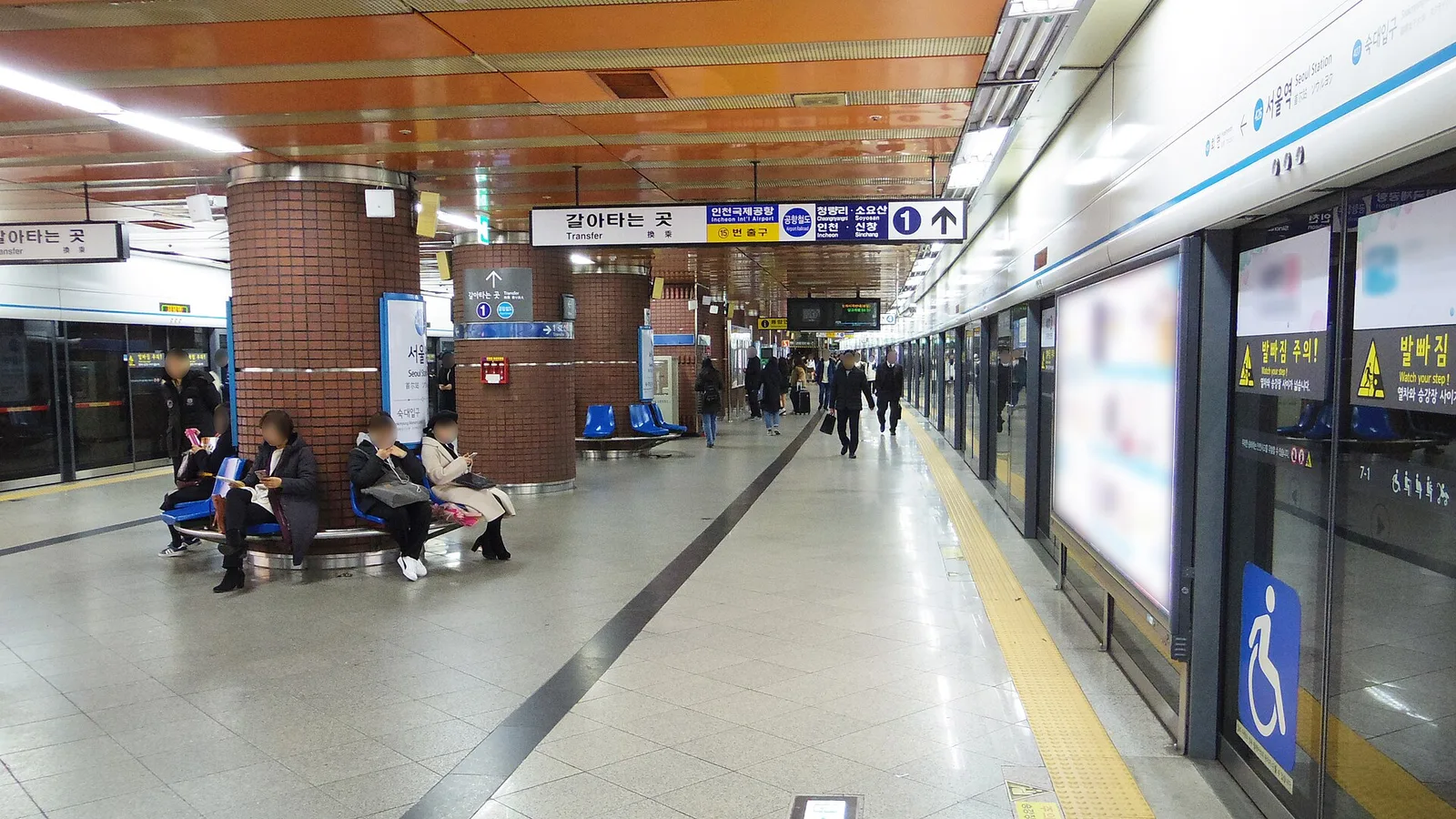
Skip to main content← All guidesThe Line 4 platform at Seoul Station. Match the line, direction and destination shown on live station signs.Photo: LERK · CC BY-SA 4.0 · resized
TRANSPORT · GUIDE
Using the Seoul subway and buses
Save the exact Korean destination, verify the live line and direction, use a compatible transit product, and keep the final exit, bus stop and last useful departure in the same route plan.
Any Seoul station→Anywhere else in Seoul
USE IT ON THE TRIP
Keep this guide for the day you need it.
Add it to an itinerary, or ask travelers when one detail may have changed since the last official check.
LAST CHECKEDAugust 24, 202620 days ago. Fares, routes and final train times change—confirm live before you travel.
WHAT TO DO
Follow the trip in order.
Scan the essentials first. Open a step only when you need the detail.
Before boarding
1Save the exact destination in KoreanKeep the Korean place name, road address and branch or entrance detail together.
Keep the Korean place name, road address and branch or entrance detail together. In the route app, confirm that the selected pin matches the district and not just a similar English name.
Look for 장소명 · 도로명주소 · 지점
Watch out A hotel name, café name or attraction can have multiple branches. Save a public destination, not a room number or door code.
2Build the complete live routeCheck the departure entrance or stop, line and direction, transfer stations, destination exit and final walk in a Korea-supported map.
Check the departure entrance or stop, line and direction, transfer stations, destination exit and final walk in a Korea-supported map. Compare the planned arrival with any booking or venue cutoff.
Watch out A saved screenshot cannot reflect a delay, closed entrance, elevator outage or changed bus arrival. Refresh essential legs before leaving.
3Choose and fund the exact transit productUse a reloadable transit card for ordinary pay-as-you-go travel, or compare a time pass only after checking every planned line and airport or regio…
Use a reloadable transit card for ordinary pay-as-you-go travel, or compare a time pass only after checking every planned line and airport or regional boundary. Confirm the current purchase and reload method at that seller or machine.
Look for 교통카드 · 충전 · 이용범위
Watch out Do not assume an international card accepted by one new machine will buy or reload every product. Keep a modest KRW backup.
Start the trip
4Match the subway line, direction and platformAt the station, match the line color or number and the direction using the next station or terminal station shown on current signs.
At the station, match the line color or number and the direction using the next station or terminal station shown on current signs. Recheck at interchanges before entering the next platform.
Look for 노선 · 방면 · 다음 역 · 승강장
Watch out The same station name can serve several lines, and opposite platforms may not connect after the gate.
5Complete each tap and transferWait for the reader or gate to confirm each entry and exit.
Wait for the reader or gate to confirm each entry and exit. Follow signed transfer corridors inside the station, and tap when boarding and leaving a bus so an eligible transfer can be calculated.
Look for 승차 · 하차 · 환승
Watch out If the gate rejects the card or the balance looks wrong, stop and ask staff instead of tapping repeatedly or following another passenger through.
6Use the correct exit or accessible routeBefore leaving the platform, check the route's exit number and whether you need an elevator or another accessible entrance.
Before leaving the platform, check the route's exit number and whether you need an elevator or another accessible entrance. Follow current station signs because construction and closures can change the walk.
Look for 나가는 곳 · 출구 · 엘리베이터
Watch out The nearest numbered exit is not automatically step-free or the safest choice with luggage.
During the trip
7Match the bus stop, route number and directionUse the stop ID or Korean stop name and confirm that your route number appears for the correct direction.
Use the stop ID or Korean stop name and confirm that your route number appears for the correct direction. At the vehicle, match the number and destination display, then follow its door and card-reader signs.
Look for 정류장 ID · 버스 번호 · 방면 · 하차벨
Watch out Stops with similar names can sit across a wide road or intersection. A bus approaching the map pin is not proof it travels your direction.
8Protect the last useful departure and fallbackCheck the last useful train or bus for every remaining transfer, not only the first departure.
Check the last useful train or bus for every remaining transfer, not only the first departure. Save the Korean accommodation address and a traceable taxi or night-bus fallback before service ends.
Watch out A scheduled final departure can still be affected by operations, and missing one connection can invalidate the rest of the route.
COMPARE OPTIONS
Choose without rereading the page.
Option
Best for
Cost
Watch out
Subway
Trips whose exact stations, platform direction, transfer and final exit are confirmed.
See the official transport guide · Route and service dependent
Not every destination is close to a station, and large interchanges involve walking.
City bus
Short hops the subway does not cover well, and destinations partway between stations.
See the official transport guide · Traffic dependent
Stop announcements may be harder to follow. Use live bus tracking in your map app.
Taxi
After the last train, with heavy luggage, or when travelling as a group.
Current metered or disclosed app fare · Traffic dependent
Confirm the plate and destination; current surcharges and traffic affect the total.
Walking
A short, accessible route whose crossings and weather you have checked.
Free · Distance, crossings and weather dependent
Summer heat and monsoon rain change this calculation completely.
ILLUSTRATED GUIDES
See it step by step.
The same journeys drawn panel by panel, so you know what the next few minutes look like before you are standing in them.
A terminal-aware Gimpo arrival workflow covering the station connection, current bus stops, designated taxis, luggage, late arrival and the final walk without publishing a stale fare or timetable.
Sources & verification3 official sources · August 24, 2026
Check it yourself.
Every changing rule stays attached to the organization responsible for it.
A practical comparison of Tmoney, EZL, WOWPASS and Seoul's Climate Card, including where the boundaries are, why foreign cards are not a reliable top-up plan, and what to do before the last ride.
A foreign-traveler workflow for booking KTX and conventional trains, choosing the correct Seoul-area station, handling sold-out departures and deciding whether a KORAIL Pass is worth it.
An eight-step Incheon arrival workflow that compares AREX, airport buses and designated taxis without freezing fares or timetables that can change before the traveler lands.