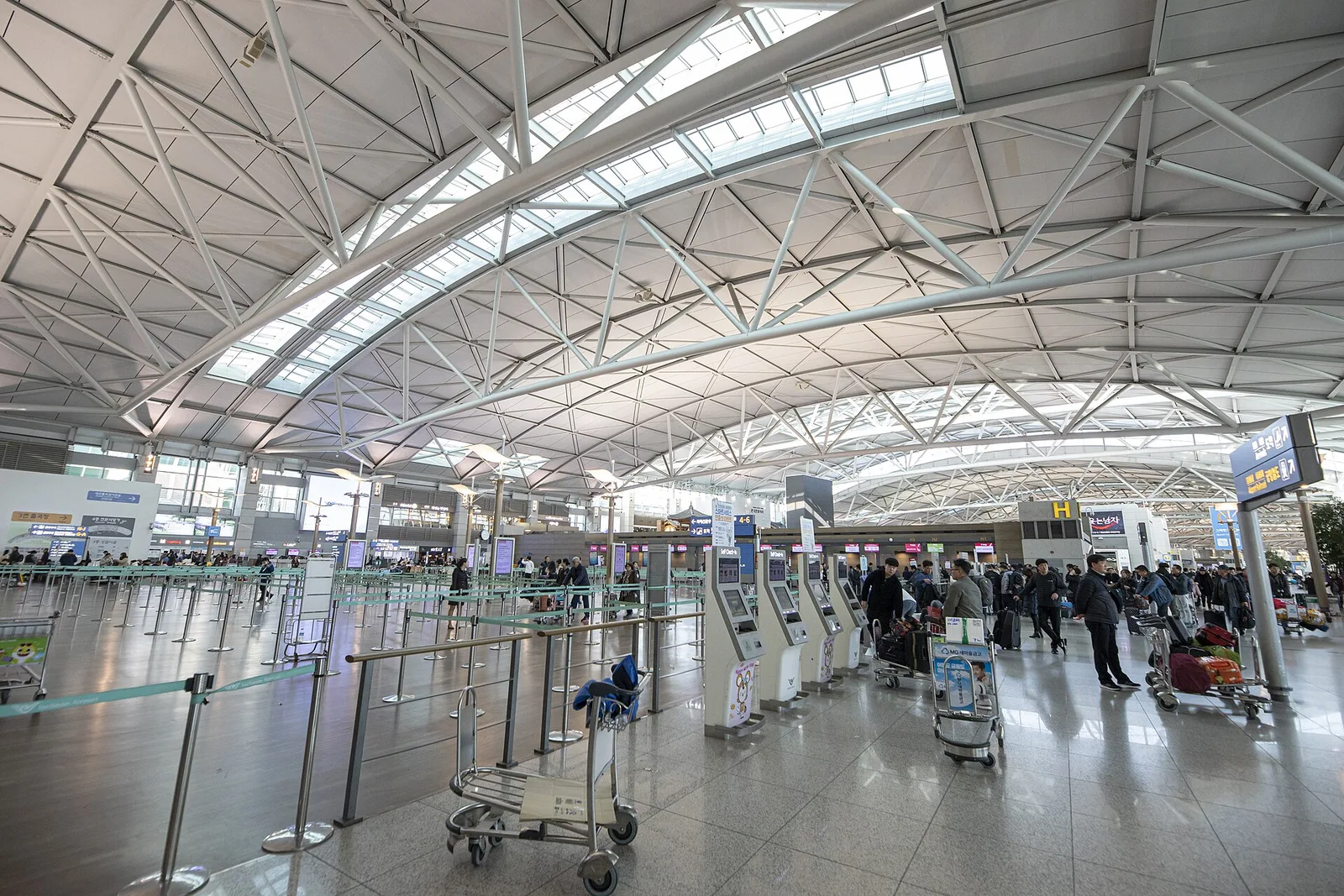
Skip to main content← All guidesIncheon Airport Terminal 1 departures hall. Check the live terminal, counter and processing time before travel.Photo: Arne Müseler · CC BY-SA 3.0 DE · resized
TRANSPORT · GUIDE
Incheon Airport to Seoul
Confirm your terminal and exact accommodation, compare each option door to door with live service, then board only after matching the ticket, platform or stand and keeping a late-arrival fallback.
Incheon International Airport, Terminal 1 or Terminal 2→Central Seoul
USE IT ON THE TRIP
Keep this guide for the day you need it.
Add it to an itinerary, or ask travelers when one detail may have changed since the last official check.
LAST CHECKEDAugust 24, 202620 days ago. Fares, routes and final train times change—confirm live before you travel.
WHAT TO DO
Follow the trip in order.
Scan the essentials first. Open a step only when you need the detail.
Before boarding
1Confirm the arrival terminal and complete arrival proceduresUse the arriving flight record to identify Terminal 1 or Terminal 2, then finish immigration, baggage and any required declaration before choosing…
Use the arriving flight record to identify Terminal 1 or Terminal 2, then finish immigration, baggage and any required declaration before choosing ground transport.
Look for Terminal 1 · Terminal 2 · Arrivals · 입국
Watch out An airline can change terminals. Check the current flight record rather than relying only on an old itinerary screenshot.
2Restore a working route or open the offline arrival packConnect through the traveler's chosen roaming, SIM, eSIM or trusted airport network, or open the saved offline route.
Connect through the traveler's chosen roaming, SIM, eSIM or trusted airport network, or open the saved offline route. Keep the Korean accommodation address and official transport links reachable without a new search.
Look for Wi-Fi · SIM · eSIM · 안내
Watch out Do not delay a safe transfer only to buy a specific data product. Staffed airport information and an offline address remain valid fallbacks.
3Match the exact accommodation and first-night cutoffVerify the Korean property name, road address, branch, entrance instructions and staffed check-in deadline.
Verify the Korean property name, road address, branch, entrance instructions and staffed check-in deadline. Use the final public stop or taxi drop-off that serves that exact entrance.
Look for 숙소명 · 도로명주소 · 체크인
Watch out Never post the room number, door code or live accommodation pin while asking a public community for directions.
Start the trip
4Compare complete door-to-door optionsFor AREX all-stop, AREX Express, an airport bus and a designated taxi, compare the live fare, departure, transfers, luggage handling, elevator path…
For AREX all-stop, AREX Express, an airport bus and a designated taxi, compare the live fare, departure, transfers, luggage handling, elevator path, final walk and arrival before check-in closes.
Watch out The fastest airport-to-station segment can lose after a long transfer or final walk. No option is universally cheapest, fastest or easiest.
5Follow terminal-specific transport signsUse the airport's current map and signs for the railroad ticket area, the exact bus stop or the designated taxi stand in your terminal.
Use the airport's current map and signs for the railroad ticket area, the exact bus stop or the designated taxi stand in your terminal. Terminal 1 and Terminal 2 have separate access points.
Look for Airport Railroad · 버스 · 택시 · Transportation Center
Watch out Do not travel to the other terminal because an old guide pictured its platform. Staff can confirm the current route from the arrival hall.
6Buy the exact ticket or confirm the taxi termsMatch the origin terminal, destination, passenger category, service type, departure and total before paying.
Match the origin terminal, destination, passenger category, service type, departure and total before paying. For a taxi, use the designated stand or verified booking and understand whether the trip is metered or uses a disclosed flat fare.
Look for 일반열차 · 직통열차 · 승차권 · 택시 승강장
Watch out Retail-card acceptance does not establish every transit ticket or reload method. Preserve the first payment result before retrying.
During the trip
7Match the platform, bus or vehicle before boardingFor rail, confirm all-stop or Express, direction and platform.
For rail, confirm all-stop or Express, direction and platform. For a bus, match route number, stop and destination. For a taxi, match the designated queue or verified booking and show the Korean address.
Watch out A nearby vehicle, a familiar logo or another traveler's queue is not proof it serves your destination.
8Keep the fallback until you reach the correct entranceKeep the ticket, receipt, route and Korean address visible until arrival.
Keep the ticket, receipt, route and Korean address visible until arrival. If a connection is missed, return to a staffed public area and recheck the airport's current late-night bus and designated taxi information.
Watch out Do not accept an unsolicited ride or follow a stranger to an unmarked vehicle when service is ending.
COMPARE OPTIONS
Choose without rereading the page.
Option
Best for
Cost
Watch out
AREX all-stop
A route whose stops and onward transfer suit the exact accommodation.
Live fare for the exact origin, destination and ticket type · Live timetable plus the final connection
It is a different product from the reserved Express service. Check seating, luggage, lift and final-exit needs.
AREX Express
A complete route where the reserved direct segment to Seoul Station still saves effort.
Live reserved-ticket fare · Live timetable plus the Seoul Station onward leg
The final transfer or walk can remove the segment-time advantage. Match the correct terminal and service before paying.
Airport limousine
An accommodation served by a current stop with a manageable walk from the drop-off.
Operator's live route fare · Published schedule plus road conditions and the final walk
Confirm the route number, terminal stop, operator, final useful departure and drop-off before buying.
Official taxi
A verified vehicle when public transport no longer completes the route or luggage and access make transfers impractical.
Current meter or disclosed official booking fare, plus applicable terms · Traffic and destination dependent
Use the designated stand or a verified booking. Confirm the vehicle, destination, toll and surcharge terms.
ILLUSTRATED GUIDES
See it step by step.
The same journeys drawn panel by panel, so you know what the next few minutes look like before you are standing in them.
Do this instead Compare the complete route through the correct terminal, ticket queue, transfers, final walk and check-in cutoff.
Following another terminal's screenshot.
Do this instead Check the current arriving-flight terminal and follow that terminal's railroad, bus or taxi signs.
Assuming a saved timetable will hold on arrival day.
Do this instead Check the official airport transport page and AREX site the day you land. Final train times in particular change.
Paying repeatedly after an unclear ticket result.
Do this instead Check the machine, receipt and account record, then ask staff before submitting the same fare again.
Assuming a bus or taxi removes every final-walk problem.
Do this instead Check the exact drop-off, building entrance, stairs and late check-in route for the accommodation.
TRAVELER FAQ
Answers before you leave.
What if I land after midnight?
Use the airport's current terminal-specific late-night bus pages and designated taxi guide after checking the accommodation's late-entry instructions. Do not rely on a stored route number or departure time.
Can I pay for AREX with a foreign card?
The answer differs between an all-stop fare, an Express reservation, a single-journey ticket and a stored-value card reload. Check the exact official ticket screen or machine and keep another accepted method available.
Which airport option is cheapest or fastest?
No one answer covers every terminal, destination, ticket type, transfer and travel date. Compare the live complete route and total shown by the official operator for the exact trip.
How do I tell a taxi driver where I am going?
Show the exact Korean property name and road address, confirm the destination before departure and keep private access codes hidden.
Which is better for Hongdae?
The all-stop train serves Hongik Univ. Station, but compare the correct terminal departure, final exit, luggage route and accommodation walk with a current airport bus or designated taxi.
A terminal-aware Gimpo arrival workflow covering the station connection, current bus stops, designated taxis, luggage, late arrival and the final walk without publishing a stale fare or timetable.
A five-way Seoul-to-Busan transport comparison that separates operators and terminals, exposes airport and station transfer time, and provides a safe booking workflow for foreign travelers.
Sources & verification7 official sources · August 24, 2026
Check it yourself.
Every changing rule stays attached to the organization responsible for it.
A practical comparison of Tmoney, EZL, WOWPASS and Seoul's Climate Card, including where the boundaries are, why foreign cards are not a reliable top-up plan, and what to do before the last ride.
An eight-step Seoul route workflow covering Korean place names, live directions, transit products, platform direction, taps, exits and elevators, bus stops, and late-night recovery.
A foreign-traveler workflow for booking KTX and conventional trains, choosing the correct Seoul-area station, handling sold-out departures and deciding whether a KORAIL Pass is worth it.