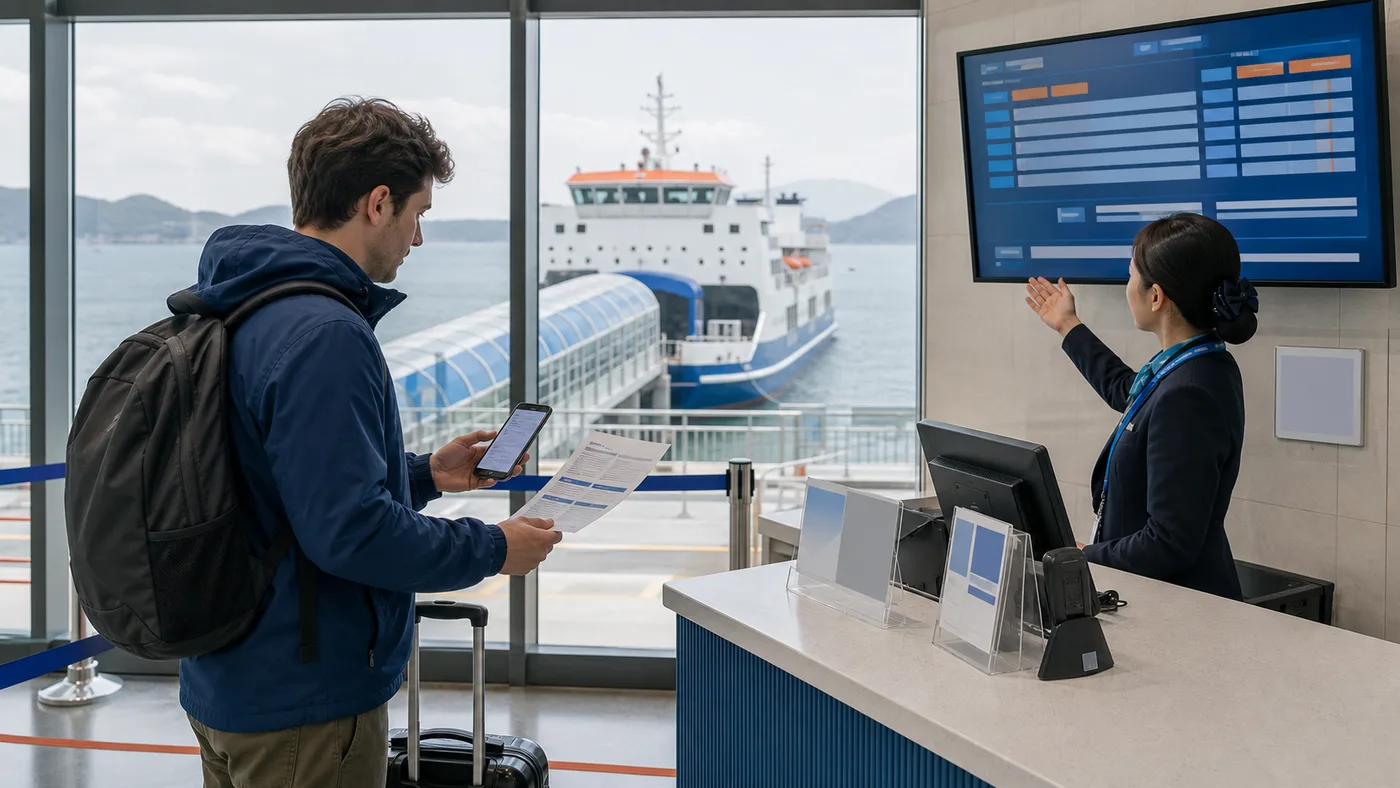
Skip to main content← All guidesConceptual terminal-and-return check, not a real port, route, sailing status or boarding document. Match the exact terminals, operator and vessel, then recheck the operator and KOMSA on the travel day because weather and vessel conditions can change operation.Illustration: Korea Era editorial studio · Korea Era original editorial image
TRANSPORT · GUIDE
Taking Ferries to Korean Islands
Match the exact mainland and island terminals, sailing operator, passenger details and live operation status, then protect identification, seasickness, baggage and a weather-safe return rather than treating a ferry as a fixed timetable.
A mainland or island passenger-ferry terminal→The correct island terminal with a confirmed return plan
USE IT ON THE TRIP
Keep this guide for the day you need it.
Add it to an itinerary, or ask travelers when one detail may have changed since the last official check.
LAST CHECKEDAugust 24, 202620 days ago. Fares, routes and final train times change—confirm live before you travel.
WHAT TO DO
Follow the trip in order.
Scan the essentials first. Open a step only when you need the detail.
Before boarding
1Identify the exact route and terminal pairMatch the licensed route, mainland terminal, island terminal, direction and travel date.
Match the licensed route, mainland terminal, island terminal, direction and travel date. Save both Korean terminal names and road addresses.
Watch out A city can have several ports, piers or terminals that are not walkable substitutes.
2Read the operator's current passenger rulesConfirm booking channel, passenger-name and identification requirements, check-in cutoff, baggage, vehicle, pet and cancellation terms before paying.
Confirm booking channel, passenger-name and identification requirements, check-in cutoff, baggage, vehicle, pet and cancellation terms before paying.
Watch out A passenger ticket does not automatically include a vehicle, bicycle, oversized bag or pet.
Start the trip
3Check live operation before leavingUse the ferry operator and KOMSA operation information for the actual sailing, then confirm ground transport to the terminal and the weather-safe r…
Use the ferry operator and KOMSA operation information for the actual sailing, then confirm ground transport to the terminal and the weather-safe route back.
Watch out A scheduled departure can be delayed or cancelled after a screenshot was saved.
During the trip
4Board and return from the named terminalMatch the vessel, route, direction and boarding call.
Match the vessel, route, direction and boarding call. Keep the return ticket, operator contact and an island accommodation or cancellation fallback available offline.
Watch out Do not cross barriers, approach working ramps or wait on exposed harbor edges for a photograph.
COMPARE OPTIONS
Choose without rereading the page.
Option
Best for
Cost
Watch out
Booked passenger ferry
An island with a confirmed same-day or overnight plan
Current operator total · Sailing and check-in dependent
Weather, identification and terminal rules remain live.
Mainland alternative day
A cancelled sailing or fragile final-day connection
Reprice the itinerary · No marine crossing
Do not pressure an operator or board an unsafe alternative to preserve a booking.
AVOID THESE MISTAKES
2 mistakes worth remembering.
Saving only the island name.
Do this instead Save both exact terminals, operator, route, direction and boarding point.
Planning a flight after the last possible return.
Do this instead Protect cancellation and weather buffer before a fixed departure from Korea.
TRAVELER FAQ
Answers before you leave.
Can a ferry be cancelled on the day?
Yes. Sea and weather conditions can change operation; the current operator and KOMSA status outrank a stored timetable.
Can I bring a rental car?
Only if the exact operator, vessel and rental agreement allow it and a vehicle space is booked. A passenger reservation alone is not enough.
What if the return is cancelled?
Follow the operator's instructions, secure lawful accommodation or an approved alternative, and rework every onward reservation rather than seeking an unofficial boat.
How to reach Korean cities by long-distance bus: express versus intercity services, official booking sites, terminal matching, ticket collection, luggage and the return trip.
A foreign-traveler workflow for booking KTX and conventional trains, choosing the correct Seoul-area station, handling sold-out departures and deciding whether a KORAIL Pass is worth it.
A practical comparison of Tmoney, EZL, WOWPASS and Seoul's Climate Card, including where the boundaries are, why foreign cards are not a reliable top-up plan, and what to do before the last ride.
Sources & verification4 official sources · August 24, 2026
Check it yourself.
Every changing rule stays attached to the organization responsible for it.
An eight-step Seoul route workflow covering Korean place names, live directions, transit products, platform direction, taps, exits and elevators, bus stops, and late-night recovery.
How to choose between station lockers, Seoul T-Luggage storage and same-day delivery, with size checks, operating-hour limits, prohibited items and a safe handoff record.
A decision and pickup checklist for driving in Korea, including licence documents, insurance, tolls, navigation, parking, fuel, road rules and collision records.