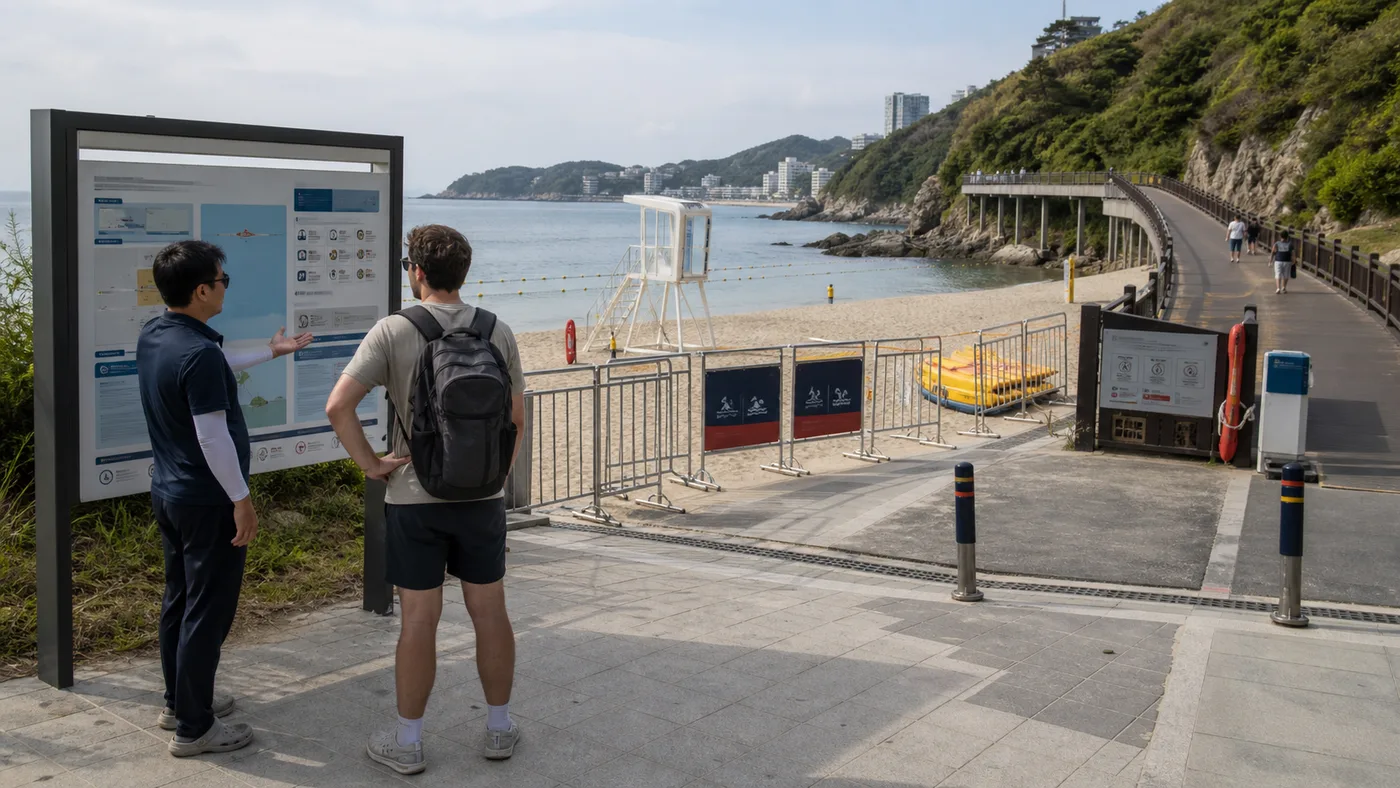
Skip to main content← All guidesConceptual same-day beach check, not a real beach, opening notice or safety assessment. Confirm the named beach in BadaOn and with its local authority, read current marine conditions, and obey on-site staff, barriers and closures.Illustration: Korea Era editorial studio · Korea Era original editorial image
SAFETY · GUIDE
Beach and Coastal Safety in Korea
Use an officially managed open beach, check current wind, waves, tide and local controls, stay inside marked areas with the required safety equipment, and call 119 rather than entering dangerous water to attempt a rescue.
A planned beach, island or coastal stop→A managed visit completed outside restricted water and structures
USE IT ON THE TRIP
Keep this guide for the day you need it.
Add it to an itinerary, or ask travelers when one detail may have changed since the last official check.
LAST CHECKEDAugust 24, 202620 days ago. Fares, routes and final train times change—confirm live before you travel.
WHAT TO DO
Follow the trip in order.
Scan the essentials first. Open a step only when you need the detail.
Prepare
1Confirm the coast is open and managedCheck the responsible local authority or operator for opening, swimming zone, lifeguard period, access restrictions and the exact Korean entrance.
Check the responsible local authority or operator for opening, swimming zone, lifeguard period, access restrictions and the exact Korean entrance.
Watch out An unstaffed or undesignated beach is not made safe by other people swimming there.
2Read weather, waves and tideUse KMA and local marine information on the visit day.
Use KMA and local marine information on the visit day. Cancel water entry and exposed rocks or breakwaters when warnings, barriers or conditions require it.
Watch out A sunny sky does not rule out dangerous swell, current, tide or distant weather.
Act now
3Stay inside the managed activityFollow flags, lifeguards and marked zones; wear the appropriate life jacket and operator-required equipment for water activities.
Follow flags, lifeguards and marked zones; wear the appropriate life jacket and operator-required equipment for water activities. Keep children and companions within active supervision.
Watch out Do not swim alone, climb tetrapods or enter ports, mudflats and rocks without current permission and timing.
Follow up
4Respond without becoming another casualtyAlert lifeguards and call 119, point to the person and use a reachable flotation device or rope when instructed.
Alert lifeguards and call 119, point to the person and use a reachable flotation device or rope when instructed. Do not jump into dangerous water without training and equipment.
Watch out Recording or crowding the rescue area delays help and exposes more people.
COMPARE OPTIONS
Choose without rereading the page.
Option
Best for
Cost
Watch out
Managed open beach
Ordinary swimming and family visits
Facility dependent · Within current supervised hours
Obey the marked zone, staff and same-day conditions.
Dry coastal viewpoint or promenade
A no-swim day or rough water
Route dependent · Weather dependent
Stay behind barriers and away from wave-wet rocks, breakwaters and cliff edges.
AVOID THESE MISTAKES
2 mistakes worth remembering.
Entering where locals appear to enter.
Do this instead Use the current managed area and responsible authority's rules.
Running into the water to help immediately.
Do this instead Call 119, alert trained staff and use rescue equipment without creating another victim.
TRAVELER FAQ
Answers before you leave.
Is a closed beach safe for walking?
Not automatically. Swimming closure, wave controls, storm damage and access closure are different; obey the current signs and barriers.
Can I stand on tetrapods or breakwaters for a photo?
Do not enter restricted or exposed structures. Sudden waves, gaps and slippery surfaces make them dangerous even in calm-looking weather.
What should I do if someone is in trouble?
Alert lifeguards and call 119, keep sight of the person and use available rescue equipment as directed. Do not enter dangerous water without training and protection.
A location-specific air-quality workflow for PM2.5, PM10, ozone and yellow dust that separates official measurements, forecasts, personal health advice and the decision to shorten or move an outdoor day.
A live-information workflow for heat, heavy rain, typhoons, snow, strong wind, waves and earthquakes that separates forecasts, government alerts, operator closures and emergency dispatch.
A traveler-safe path through Korean pharmacies, clinics, hospitals and emergency care, including interpretation, medication records, bills and travel-insurance evidence.
A recoverable sequence for property lost in Korean taxis, transit, venues or streets, with Lost112 search, police reporting, phone protection, insurance evidence and passport replacement.
A help-channel decision guide that separates ordinary travel questions, interpretation, documented tourism complaints, payment disputes and emergencies without posting receipts or personal details publicly.