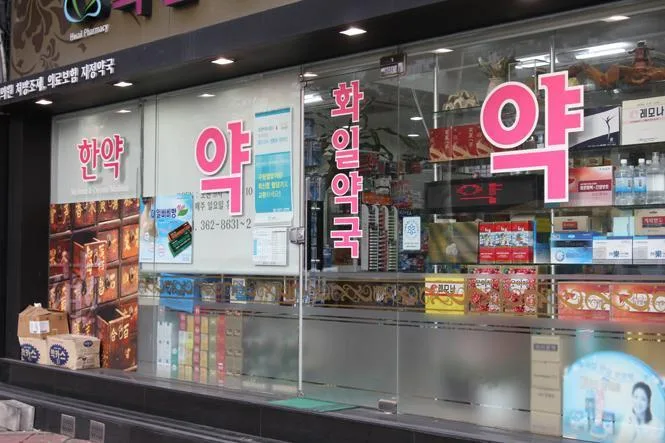
Skip to main content← All guidesA Korean pharmacy identified by the large 약 sign. A pharmacy is not the same as a clinic or emergency department.Photo: Andrewssi2 · CC BY-SA 3.0 · resized
SAFETY · GUIDE
Pharmacies, clinics and medical help in Korea
Call 119 for a medical emergency, use a pharmacy only for non-emergency advice and medicines within its role, and bring your symptoms, medicines, allergies and insurance details to a clinic or hospital.
Feeling unwell or needing medication in Korea→The appropriate level of care with a usable record
USE IT ON THE TRIP
Keep this guide for the day you need it.
Add it to an itinerary, or ask travelers when one detail may have changed since the last official check.
LAST CHECKEDAugust 22, 202622 days ago. Fares, routes and final train times change—confirm live before you travel.
WHAT TO DO
Follow the trip in order.
Scan the essentials first. Open a step only when you need the detail.
Prepare
1Decide whether this is an emergencyFor severe breathing difficulty, collapse, major bleeding, chest pain, stroke signs or another immediate threat, call 119 and give your location fi…
For severe breathing difficulty, collapse, major bleeding, chest pain, stroke signs or another immediate threat, call 119 and give your location first.
Watch out Do not delay emergency care to search for an English-speaking facility.
2Prepare a concise medical noteWrite symptoms, when they started, current medicines with generic names and doses, allergies, conditions and a reachable emergency contact in Korea…
Write symptoms, when they started, current medicines with generic names and doses, allergies, conditions and a reachable emergency contact in Korean and English where possible.
Act now
3Use the appropriate first stopA pharmacy can help with non-emergency over-the-counter needs and direct you onward.
A pharmacy can help with non-emergency over-the-counter needs and direct you onward. Use a clinic or hospital when examination, diagnosis, a prescription or urgent treatment may be needed.
Look for 약국 · 의원 · 병원 · 응급실
4Ask for interpretation without delaying careLarge hospitals may have international care centers.
Large hospitals may have international care centers. For non-emergency travel interpretation, use 1330; in an emergency, call 119 first.
Follow up
5Confirm every medicine before taking itCheck the active ingredient, dose, timing, interactions and whether it duplicates something you already take.
Check the active ingredient, dose, timing, interactions and whether it duplicates something you already take. Keep the labeled package and receipt.
Watch out A familiar brand name can contain a different formulation in another country.
6Collect records for follow-up and insuranceAsk for an itemized bill, medical note or prescription record as available, and keep payment evidence.
Ask for an itemized bill, medical note or prescription record as available, and keep payment evidence. Contact your insurer through its official channel as soon as practical.
COMPARE OPTIONS
Choose without rereading the page.
Option
Best for
Cost
Watch out
Pharmacy
Non-emergency medicine questions and products within the pharmacist's role.
Medicine and consultation-dependent · Walk-in during opening hours
A pharmacy does not replace examination or emergency care.
Clinic or hospital outpatient care
Symptoms requiring examination, diagnosis, prescription or follow-up.
Facility and treatment-dependent · Walk-in or appointment depending on facility
Language support, hours and payment arrangements vary.
Emergency medical service
A serious or rapidly worsening condition.
Treatment and transport rules vary · Immediate response through 119
Give location first and do not wait for travel-insurance approval.
AVOID THESE MISTAKES
4 mistakes worth remembering.
Using 1330 instead of 119 during a medical emergency.
Do this instead Call 119 first; interpretation and travel assistance can follow.
Showing only a foreign brand name for a medicine.
Do this instead Provide the generic ingredient, dose and a photo of the labeled package.
Taking a new medicine without checking duplication or interactions.
Do this instead Show the pharmacist or clinician everything you already take and your allergies.
Leaving without bills or treatment records.
Do this instead Collect itemized payment and care records before departure when possible.
TRAVELER FAQ
Answers before you leave.
What number is medical emergency help in Korea?
Call 119 for emergency medical services. Give your location first, then describe the condition.
Can a pharmacy diagnose me?
A pharmacist can advise within the pharmacy role, but symptoms needing examination, diagnosis or urgent treatment belong at a clinic, hospital or emergency service.
How do I find language support?
Many large hospitals have international care centers. For non-emergency travel interpretation, contact 1330; do not delay 119 in an emergency.
What medicine information should I bring?
Bring generic ingredient names, doses, schedule, reason for use, allergies and photos of original labeled packages.
What should I keep for travel insurance?
Keep itemized bills, receipts, prescription or treatment records and the insurer's case reference, subject to your policy's requirements.
A coast-specific safety workflow for beaches, rocks, breakwaters, mudflats and water activities that treats lifeguards, barriers, weather and local controls as live conditions rather than scenery.
A location-specific air-quality workflow for PM2.5, PM10, ozone and yellow dust that separates official measurements, forecasts, personal health advice and the decision to shorten or move an outdoor day.
A live-information workflow for heat, heavy rain, typhoons, snow, strong wind, waves and earthquakes that separates forecasts, government alerts, operator closures and emergency dispatch.
Sources & verification3 official sources · August 22, 2026
Check it yourself.
Every changing rule stays attached to the organization responsible for it.
A recoverable sequence for property lost in Korean taxis, transit, venues or streets, with Lost112 search, police reporting, phone protection, insurance evidence and passport replacement.
A help-channel decision guide that separates ordinary travel questions, interpretation, documented tourism complaints, payment disputes and emergencies without posting receipts or personal details publicly.