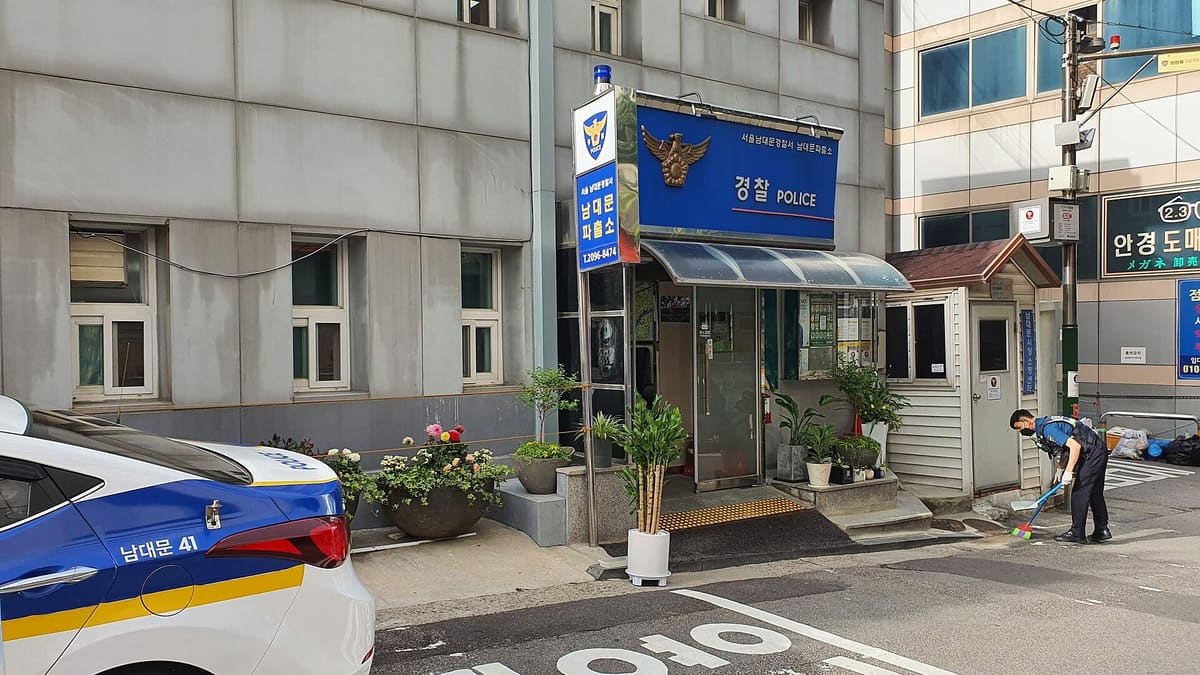
Skip to main content← All guidesA 파출소 — a neighbourhood police box in Seoul. The photograph does not prove current staffing or opening; call 112 for immediate danger or an active crime.Photo: Twotwo2019 · CC BY-SA 4.0 · resized
SAFETY · GUIDE
Getting help in an emergency in Korea
Call 112 for police response to crime or danger, 119 for fire, rescue or emergency medical dispatch, and use 1330 only for non-emergency travel information and interpretation.
Something has gone wrong→Reaching the right service
USE IT ON THE TRIP
Keep this guide for the day you need it.
Add it to an itinerary, or ask travelers when one detail may have changed since the last official check.
LAST CHECKEDAugust 24, 202620 days ago. Fares, routes and final train times change—confirm live before you travel.
WHAT TO DO
Follow the trip in order.
Scan the essentials first. Open a step only when you need the detail.
Prepare
1Decide which service you needUse 112 for an active crime, violence, threat or police danger.
Use 112 for an active crime, violence, threat or police danger. Use 119 for fire, rescue or a medical emergency. Use 1330 for non-emergency tourism information and interpretation, and follow your own embassy or consulate for passport replacement.
Watch out Do not wait for 1330, a community reply, an insurer or an English-speaking facility when somebody is in immediate danger. Call 112 or 119 first.
2Say where you are, as precisely as you canLead with the Korean road address, station and exit, building name, floor or a visible landmark.
Lead with the Korean road address, station and exit, building name, floor or a visible landmark. Read the map pin aloud or ask a nearby staff member to help identify the location while you stay on the line.
Look for 도로명주소 · 역 이름 · 출구 번호 · 건물명 · 층
Watch out An English business name may not be recognisable. Prefer the station, the address, or a landmark.
Act now
3Ask for interpretation if you need itSay your language after the location and emergency type and follow the dispatcher's instructions.
Say your language after the location and emergency type and follow the dispatcher's instructions. For a non-emergency travel conversation, the 1330 hotline and its current online channels can provide tourism information and interpretation.
Watch out Interpretation availability and language support can vary by channel and time. It must not delay an emergency call or urgent treatment.
4Save your accommodation address in Korean nowKeep the accommodation name, Korean road address and phone number offline for a safe return after the incident.
Keep the accommodation name, Korean road address and phone number offline for a safe return after the incident. Also make sure your phone can show your live location independently; the hotel address is not your emergency location when you are elsewhere.
Watch out Looking this up under stress, possibly without data, is the situation to avoid.
Follow up
5Keep your embassy details reachable offlineFor a lost passport, detention or consular problem, use your own government's official embassy or consulate contact and follow its country-specific…
For a lost passport, detention or consular problem, use your own government's official embassy or consulate contact and follow its country-specific document instructions. Save the normal and emergency channels before travel.
Watch out A police loss report is not a replacement passport, and an embassy cannot override Korean law, guarantee release, pay treatment costs or restore onward-entry permission.
6Report a scam or a service problemPreserve the receipt, listing, messages and payment record.
Preserve the receipt, listing, messages and payment record. Use 112 for an active crime or immediate threat; otherwise use the relevant operator, card issuer, consumer or police reporting route. 1330 can provide tourism information, interpretation and complaint guidance, but it does not decide a refund or criminal case.
COMPARE OPTIONS
Choose without rereading the page.
Option
Best for
Cost
Watch out
112 — Police
An active crime, violence, threat or immediate police danger.
Emergency line · Dispatch depends on the incident and location
An emergency line. Not for information requests.
119 — Fire and ambulance
Medical emergencies, fire, rescue.
Emergency line; treatment costs are separate · Dispatch depends on the incident and location
Treatment costs are separate from the call. Travel insurance matters here.
1330 — Travel helpline
Non-emergency tourism information, interpretation and tourist complaint guidance.
Official service; phone or data charges can depend on the channel · Current channel and language availability
Not an emergency service. Do not use it in place of 112 or 119.
Your embassy or consulate
Lost or stolen passports, detention, serious legal problems.
Varies · Office hours, with emergency contacts
An embassy cannot override Korean law or pay your medical bills.
ILLUSTRATED GUIDES
See it step by step.
The same journeys drawn panel by panel, so you know what the next few minutes look like before you are standing in them.
Do this instead Call 112 or 119 first. 1330 is a helpline, not an emergency dispatcher.
Describing your location by an English business name.
Do this instead Give the subway station and exit number, or the road address. Those are recognisable.
Not saving your accommodation address in Korean.
Do this instead Save it on arrival day. You need it for taxis regardless, and in an emergency it removes a delay.
Assuming your travel insurance covers everything.
Do this instead Check what your policy actually covers before you travel. The ambulance call and the treatment are separate matters.
TRAVELER FAQ
Answers before you leave.
Does anyone answering 112 or 119 speak English?
Official guidance describes interpretation support, but do not assume the first person who answers shares your language. Lead with the location and emergency type, then state your language and follow instructions.
Is 1330 free?
It is Korea's official tourism helpline. The service offers non-emergency information and interpretation, while normal carrier or data charges can depend on how you connect. It is not emergency dispatch.
What do I do about a lost passport?
Contact your own embassy or consulate immediately and follow its instructions about police documentation, identity photos, forms and replacement travel documents. A police receipt alone is not a passport.
Who do I call if I am lost late at night?
Move to a lit staffed place, identify your location and rebuild the route in a Korean map. Use 1330 for non-emergency travel information or interpretation; call 112 if there is a threat, stalking, crime or immediate danger.
Will an ambulance take me to a hospital that speaks English?
You cannot count on a particular language or hospital. Do not delay 119 to search for an English-speaking facility; give the location and emergency first, request language help and let responders choose care for the situation.
A coast-specific safety workflow for beaches, rocks, breakwaters, mudflats and water activities that treats lifeguards, barriers, weather and local controls as live conditions rather than scenery.
A location-specific air-quality workflow for PM2.5, PM10, ozone and yellow dust that separates official measurements, forecasts, personal health advice and the decision to shorten or move an outdoor day.
A live-information workflow for heat, heavy rain, typhoons, snow, strong wind, waves and earthquakes that separates forecasts, government alerts, operator closures and emergency dispatch.
Sources & verification5 official sources · August 24, 2026
Check it yourself.
Every changing rule stays attached to the organization responsible for it.
A traveler-safe path through Korean pharmacies, clinics, hospitals and emergency care, including interpretation, medication records, bills and travel-insurance evidence.
A recoverable sequence for property lost in Korean taxis, transit, venues or streets, with Lost112 search, police reporting, phone protection, insurance evidence and passport replacement.
A help-channel decision guide that separates ordinary travel questions, interpretation, documented tourism complaints, payment disputes and emergencies without posting receipts or personal details publicly.