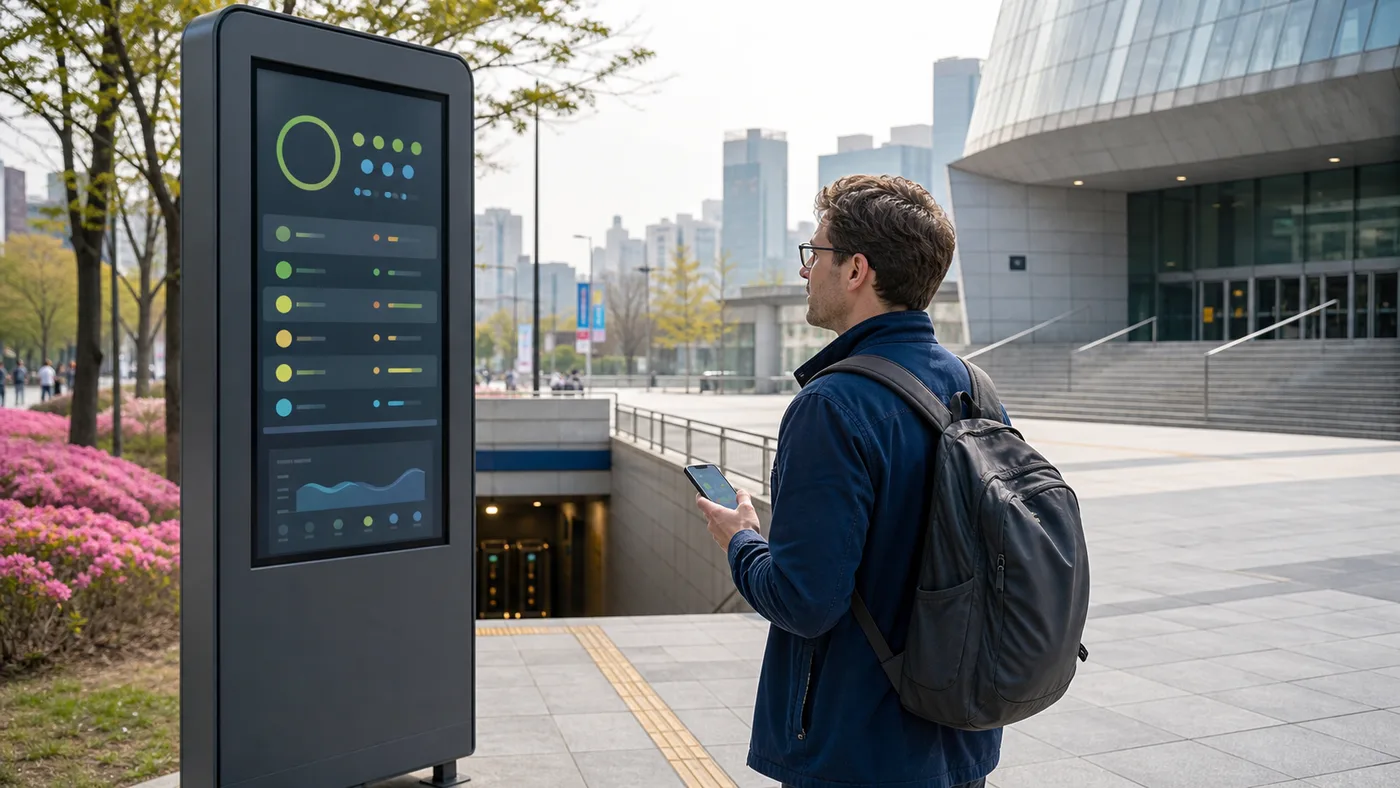
Skip to main content← All guidesConceptual location-and-activity check, not a real AirKorea screen, station reading, forecast or medical recommendation. Open the current official station and forecast for the actual route, then follow personal clinical advice and stop for concerning symptoms.Illustration: Korea Era editorial studio · Korea Era original editorial image
SAFETY · GUIDE
Checking Air Quality and Yellow Dust in Korea
Check the current AirKorea station and responsible pollutant for the actual city, follow health guidance appropriate to the traveler, and move strenuous outdoor plans rather than relying on a generic weather icon or yesterday's screenshot.
An outdoor plan or air-quality concern→A location-appropriate outdoor, reduced or indoor plan
USE IT ON THE TRIP
Keep this guide for the day you need it.
Add it to an itinerary, or ask travelers when one detail may have changed since the last official check.
LAST CHECKEDAugust 24, 202620 days ago. Fares, routes and final train times change—confirm live before you travel.
WHAT TO DO
Follow the trip in order.
Scan the essentials first. Open a step only when you need the detail.
Prepare
1Select the actual region and stationOpen AirKorea, choose the city or nearby monitoring station and read the measurement time, overall category and responsible pollutant.
Open AirKorea, choose the city or nearby monitoring station and read the measurement time, overall category and responsible pollutant.
Watch out A station across the country or a yesterday screenshot does not describe the current route.
2Separate current data from forecastUse current measurement for now and the official forecast or alert for the planned period.
Use current measurement for now and the official forecast or alert for the planned period. Recheck before a long outdoor or mountain segment.
Watch out A forecast is not a promise and a single hourly observation is not the whole day.
Act now
3Adapt the actual activityReduce strenuous or long outdoor exposure, move to a verified indoor venue or shorten the route according to official guidance and personal health…
Reduce strenuous or long outdoor exposure, move to a verified indoor venue or shorten the route according to official guidance and personal health needs.
Watch out Do not advise another traveler to ignore symptoms because the general index appears acceptable.
Follow up
4Escalate symptoms appropriatelyFollow the traveler's medical plan and seek clinical help for concerning symptoms; call 119 for a medical emergency.
Follow the traveler's medical plan and seek clinical help for concerning symptoms; call 119 for a medical emergency. Keep medication and insurance information private.
Watch out Community is not a diagnostic service and cannot determine a safe personal threshold.
COMPARE OPTIONS
Choose without rereading the page.
Option
Best for
Cost
Watch out
Shortened outdoor plan
Conditions and personal guidance allow limited exposure
No fixed cost · Recheck during the day
Keep a quick indoor exit and stop for symptoms.
Verified indoor replacement
Sensitive travelers or an unhealthy period
Venue dependent · Until conditions improve
Confirm ventilation, hours and the route; indoors is not automatically pollutant-free.
AVOID THESE MISTAKES
2 mistakes worth remembering.
Using only a phone weather icon.
Do this instead Open AirKorea for the actual station, pollutant and measurement time.
Giving one mask or exposure rule to everyone.
Do this instead Follow official guidance, product instructions and individual medical advice.
TRAVELER FAQ
Answers before you leave.
What does the AirKorea color mean?
It summarizes official air-quality measurements. Open the detail to see the station, time and responsible pollutant rather than using the color alone.
Is one part of Seoul the same as another?
Not necessarily. Use the closest relevant station and time, then consider where the route will actually go.
Should I cancel the day?
Use the current official category, forecast, activity intensity and personal health advice to shorten, move indoors or cancel. Seek medical help for concerning symptoms.
A coast-specific safety workflow for beaches, rocks, breakwaters, mudflats and water activities that treats lifeguards, barriers, weather and local controls as live conditions rather than scenery.
A live-information workflow for heat, heavy rain, typhoons, snow, strong wind, waves and earthquakes that separates forecasts, government alerts, operator closures and emergency dispatch.
A traveler-safe path through Korean pharmacies, clinics, hospitals and emergency care, including interpretation, medication records, bills and travel-insurance evidence.
A recoverable sequence for property lost in Korean taxis, transit, venues or streets, with Lost112 search, police reporting, phone protection, insurance evidence and passport replacement.
A help-channel decision guide that separates ordinary travel questions, interpretation, documented tourism complaints, payment disputes and emergencies without posting receipts or personal details publicly.