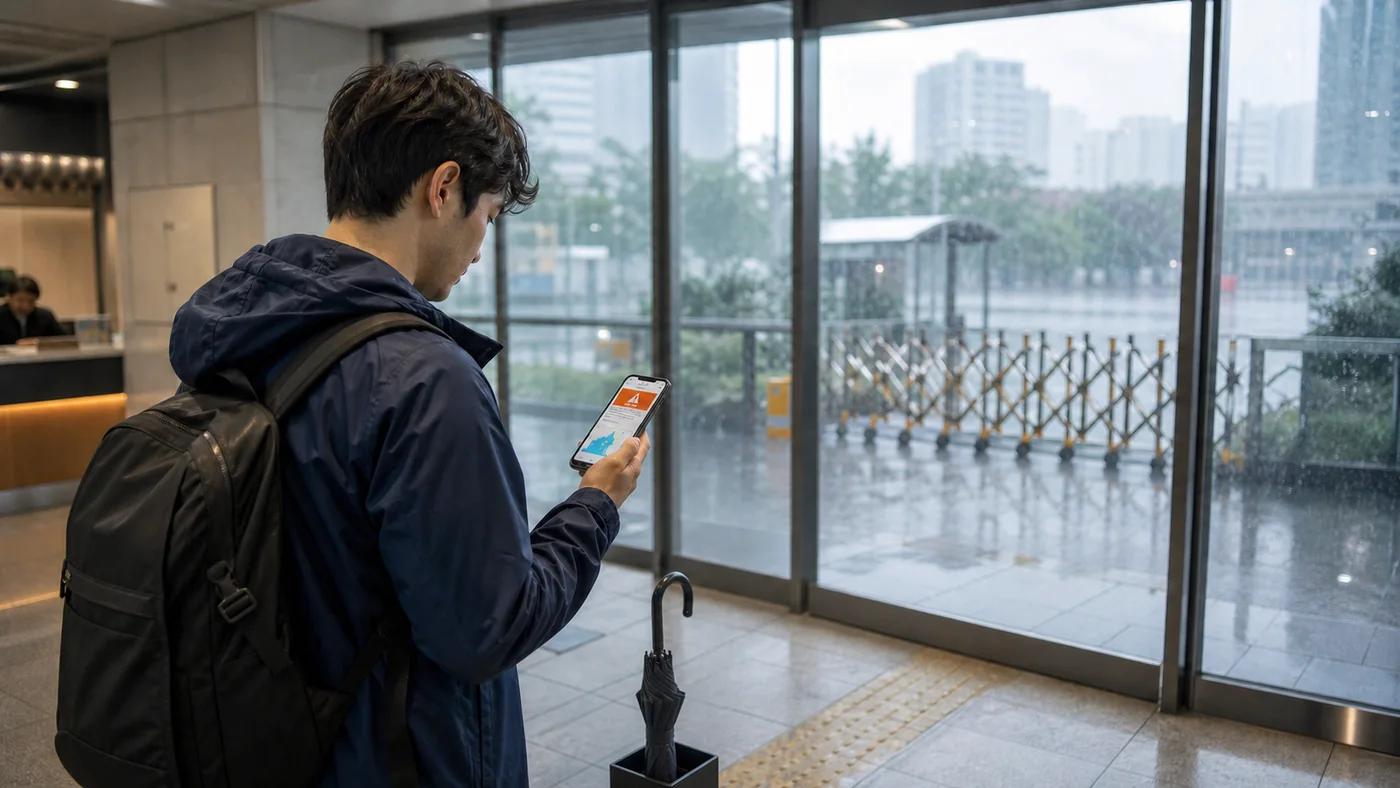
Skip to main content← All guidesConceptual stop-and-check scene, not a current warning, official app screen, live map or confirmed shelter. Match the Korean region name and issue time on live Safe Korea and KMA pages, and follow barriers and authority instructions on site.Illustration: Korea Era editorial studio · Korea Era original editorial image
SAFETY · GUIDE
Emergency Alerts and Severe Weather in Korea
Identify the affected Korean region, read the current Safe Korea alert and KMA warning, stop exposed travel when authorities restrict it, and use 112 or 119 for immediate danger rather than waiting for Community advice.
A forecast, phone alert or sudden change in conditions→A safer indoor plan or an authority-directed response
USE IT ON THE TRIP
Keep this guide for the day you need it.
Add it to an itinerary, or ask travelers when one detail may have changed since the last official check.
LAST CHECKEDAugust 24, 202620 days ago. Fares, routes and final train times change—confirm live before you travel.
WHAT TO DO
Follow the trip in order.
Scan the essentials first. Open a step only when you need the detail.
Prepare
1Match the alert to the exact place and timeRead the Korean region named in the alert, its issue time and hazard.
Read the Korean region named in the alert, its issue time and hazard. Confirm whether the route, destination or return passes through the affected area.
Watch out A nationwide-looking notification can describe one city, county, coast or sea area.
2Open the live official warningCheck Safe Korea for the alert and KMA for the current warning, forecast or earthquake information.
Check Safe Korea for the alert and KMA for the current warning, forecast or earthquake information. Use the venue or transport operator for a closure or service decision.
Watch out A translation can be imperfect and a screenshot can age; compare the original place name and timestamp.
Act now
3Remove the exposed part of the dayMove to a lawful indoor place and cancel mountains, rivers, underpasses, coasts, breakwaters, flooded roads or heat exposure when authorities or co…
Move to a lawful indoor place and cancel mountains, rivers, underpasses, coasts, breakwaters, flooded roads or heat exposure when authorities or conditions require it.
Watch out A reservation, sunset or content plan never outranks a barrier, evacuation instruction or closure.
Follow up
4Escalate through the right channelCall 112 for police and 119 for fire or medical emergencies.
Call 112 for police and 119 for fire or medical emergencies. Use 1330 only for non-emergency tourism information or interpretation after immediate safety is secured.
Watch out Do not wait for a social reply when there is immediate danger, injury, fire, flooding or a missing vulnerable person.
COMPARE OPTIONS
Choose without rereading the page.
Option
Best for
Cost
Watch out
Indoor local fallback
A warning that makes one outdoor stop unsafe
Venue dependent · Until live conditions improve
Confirm the indoor venue and the route to it are operating.
Cancel or relocate the day
Transport disruption, evacuation or widespread closure
Check booking terms · Hazard dependent
Follow authorities and operators; do not chase the edge of a warning area.
AVOID THESE MISTAKES
2 mistakes worth remembering.
Reading only a generic weather icon.
Do this instead Match the live warning, named administrative area and operator status.
Asking Community before leaving danger.
Do this instead Move to safety and call 112 or 119 when emergency response is needed.
TRAVELER FAQ
Answers before you leave.
Why did I receive a Korean-language alert?
Use the named region and issue time to find the current Safe Korea alert. Translation may be imperfect, so the official Korean place name remains important.
Does a warning mean every attraction is closed?
Not automatically. It means the hazard needs action; each responsible operator publishes the actual closure, while barriers and authority instructions are decisive.
Who should I call?
Use 112 for police emergencies and 119 for fire or medical emergencies. Use 1330 for non-emergency tourism information and interpretation.
A coast-specific safety workflow for beaches, rocks, breakwaters, mudflats and water activities that treats lifeguards, barriers, weather and local controls as live conditions rather than scenery.
A location-specific air-quality workflow for PM2.5, PM10, ozone and yellow dust that separates official measurements, forecasts, personal health advice and the decision to shorten or move an outdoor day.
A traveler-safe path through Korean pharmacies, clinics, hospitals and emergency care, including interpretation, medication records, bills and travel-insurance evidence.
A recoverable sequence for property lost in Korean taxis, transit, venues or streets, with Lost112 search, police reporting, phone protection, insurance evidence and passport replacement.
A help-channel decision guide that separates ordinary travel questions, interpretation, documented tourism complaints, payment disputes and emergencies without posting receipts or personal details publicly.