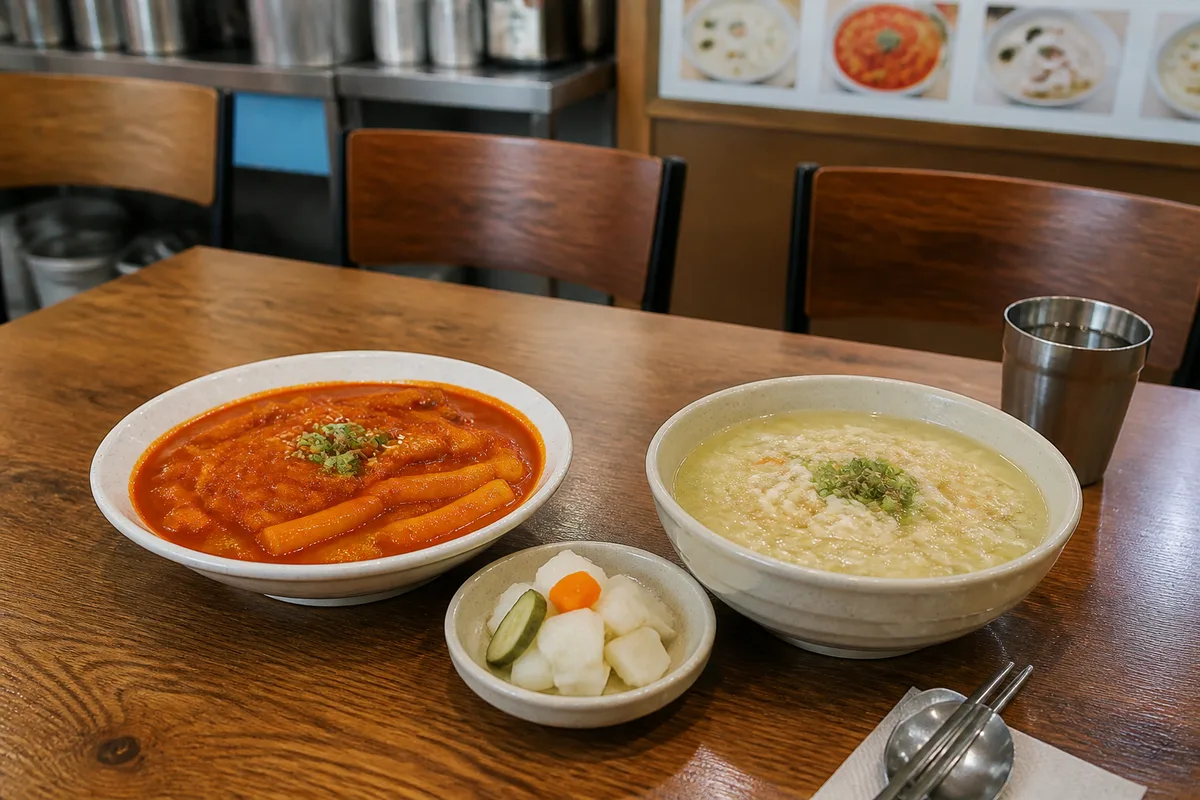
Skip to main content← All guidesAn editorial comparison of a red spicy dish and a mild-looking soup; the image is not a universal spice scale and ingredients still require confirmation.Illustration: Korea Era editorial · Korea Era original editorial image
FOOD · GUIDE
Choosing spicy or mild Korean food without guessing
Choose by the exact dish and recipe, ask whether the sauce or chili can be adjusted before ordering, and treat spice preference separately from allergies, meat, seafood and broth ingredients.
A Korean menu whose color and translated name do not explain the heat→A confirmed spicy challenge or a genuinely workable mild meal
USE IT ON THE TRIP
Keep this guide for the day you need it.
Add it to an itinerary, or ask travelers when one detail may have changed since the last official check.
LAST CHECKEDAugust 22, 202622 days ago. Fares, routes and final train times change—confirm live before you travel.
WHAT TO DO
Follow the trip in order.
Scan the essentials first. Open a step only when you need the detail.
Before ordering
1Decide whether heat is a preference or a hard limitIf you simply prefer mild food, ask for the least spicy workable option.
If you simply prefer mild food, ask for the least spicy workable option. If eating chili would create a medical problem, do not depend on a vague mild request; show a Korean restriction card and confirm the complete recipe and cross-contact limits.
Watch out A staff member agreeing that a dish is 'not too spicy' is describing taste, not providing an allergy or medical guarantee.
2Read the dish and cooking method, not just the colorRed gochujang or chili-powder sauces often signal heat, but pale broths can hide chili at the table and red dishes can range from sweet to extreme.
Red gochujang or chili-powder sauces often signal heat, but pale broths can hide chili at the table and red dishes can range from sweet to extreme. Search the exact Korean dish name and ask about that restaurant's version.
Watch out Do not build a numbered spice scale across different restaurants; the ingredients, concentration and serving size are not standardized.
At the table
3Ask two questions before orderingFirst ask '이거 많이 매워요?' (Is this very spicy?).
First ask '이거 많이 매워요?' (Is this very spicy?). Then ask '덜 맵게 가능해요?' (Can you make it less spicy?). A clear no means choose another dish rather than negotiating after the order is prepared.
Look for 이거 많이 매워요? · 덜 맵게 가능해요?
4If you want heat, confirm the exact versionTteokbokki, spicy stir-fried octopus, dakgalbi, jjamppong and spicy chicken feet are useful starting points, but names such as original, hot and ex…
Tteokbokki, spicy stir-fried octopus, dakgalbi, jjamppong and spicy chicken feet are useful starting points, but names such as original, hot and extreme are shop-specific. Confirm portion size, seafood or meat, and whether everyone sharing agrees.
Watch out Do not turn an extreme-spice challenge into a dare for someone who did not choose it, and stop if you feel unwell.
If plans change
5If you want mild food, choose an adjustable baseBibimbap with gochujang served separately, plain rice, grilled items without spicy sauce, or a clearly identified pale soup can give you more control.
Bibimbap with gochujang served separately, plain rice, grilled items without spicy sauce, or a clearly identified pale soup can give you more control. Ask what the broth and toppings contain before calling the dish vegetarian, halal or allergy-safe.
Watch out Seolleongtang, gomtang, samgyetang and many noodle soups are mild in chili but still contain meat, bones, seafood, wheat or other restricted ingredients.
6Keep one confirmed fallback mealSave one nearby restaurant or convenience meal whose full label, portion and payment method you understand.
Save one nearby restaurant or convenience meal whose full label, portion and payment method you understand. When a kitchen cannot change a batch sauce, use the fallback instead of eating a dish that does not fit your needs.
Watch out Rice, egg or a side dish can accompany a spicy meal, but they do not make an unsafe ingredient or medical reaction safe.
COMPARE OPTIONS
Choose without rereading the page.
Option
Best for
Cost
Watch out
A restaurant's clearly labeled hot dish
Travelers actively looking for heat after confirming the exact recipe and portion.
Current menu price · One meal
Hot labels are not standardized, and seafood, meat, soy, wheat or sesame may be present.
Bibimbap with gochujang on the side
Adding sauce gradually while keeping control of the heat.
Current menu price · Quick solo or group meal
Standard toppings can include beef and egg, and the sauce or side dishes may not meet dietary restrictions.
A verified mild broth or grilled dish
Travelers avoiding chili when the broth, marinade and table condiments are confirmed.
Current menu price · One meal
Mild does not mean vegetarian, halal, gluten-free or allergen-free.
A restaurant with explicit spice levels
Groups with different heat preferences when each person can choose separately.
Current menu price · One meal after a short ingredient check
The scale applies only to that restaurant and does not replace an ingredient or cross-contact check.
AVOID THESE MISTAKES
5 mistakes worth remembering.
Treating every red dish as equally spicy.
Do this instead Ask about the exact dish and that restaurant's recipe before ordering.
Assuming 'not spicy' means zero chili.
Do this instead If zero chili matters, state that directly and choose a dish the kitchen confirms can meet it.
Requesting a mild version after a batch sauce is already prepared.
Do this instead Ask whether adjustment is possible before payment and switch dishes when it is not.
Using a spice question as an allergy or religious-diet check.
Do this instead Confirm broth, sauce, toppings and cross-contact separately with a written Korean card.
Ordering one extreme shared dish for a table with mixed preferences.
Do this instead Choose separate dishes or a restaurant where each person controls the sauce and heat.
TRAVELER FAQ
Answers before you leave.
Does 빨간색 mean the food will be very spicy?
No. Red often comes from gochujang or chili powder, but sweetness, chili concentration and recipe vary. Ask about the exact menu item.
What is the simplest Korean phrase for asking about spice?
Show '이거 많이 매워요?' to ask whether the dish is very spicy, then '덜 맵게 가능해요?' to ask whether it can be made less spicy.
Can every Korean dish be made less spicy?
No. Batch sauces, marinades, stews and broths may be prepared in advance. If the kitchen says it cannot change the dish, choose a different menu item.
Which meal gives me the most control?
A dish with the spicy sauce served separately, such as bibimbap when the restaurant can separate the gochujang, gives more control than a premixed stew or stir-fry.
Is a mild Korean soup vegetarian?
Not automatically. Mild soups commonly use beef, chicken, anchovy, shellfish or other stock. Confirm the broth and toppings, not only the chili level.
What should I do if spice is a medical issue?
Use a written Korean restriction card, confirm the full recipe and cross-contact limits, and choose a different meal when the restaurant cannot answer clearly. Do not rely on a subjective mild label.
A practical Korean traditional-liquor class guide covering makgeolli and other formats, reservation and language, age and tasting, rice and nuruk allergens, sanitation, fermentation, pressure, storage, transport, customs and a dated brewery footprint.
Sources & verification4 official sources · August 22, 2026
Check it yourself.
Every changing rule stays attached to the organization responsible for it.
A safety-first food workflow for allergies, vegetarian, vegan, halal and other dietary needs, covering Korean labels, hidden stocks, cross-contact and emergency escalation.
A first traditional-market visit without payment surprises: choosing the right time, ordering a portion, asking about price and ingredients, carrying food, sorting waste and respecting working aisles and local shoppers.
A practical first visit to a Korean convenience store: choosing food, reading labels, heating a meal, handling waste, buying or reloading Tmoney and checking which services that exact branch provides.