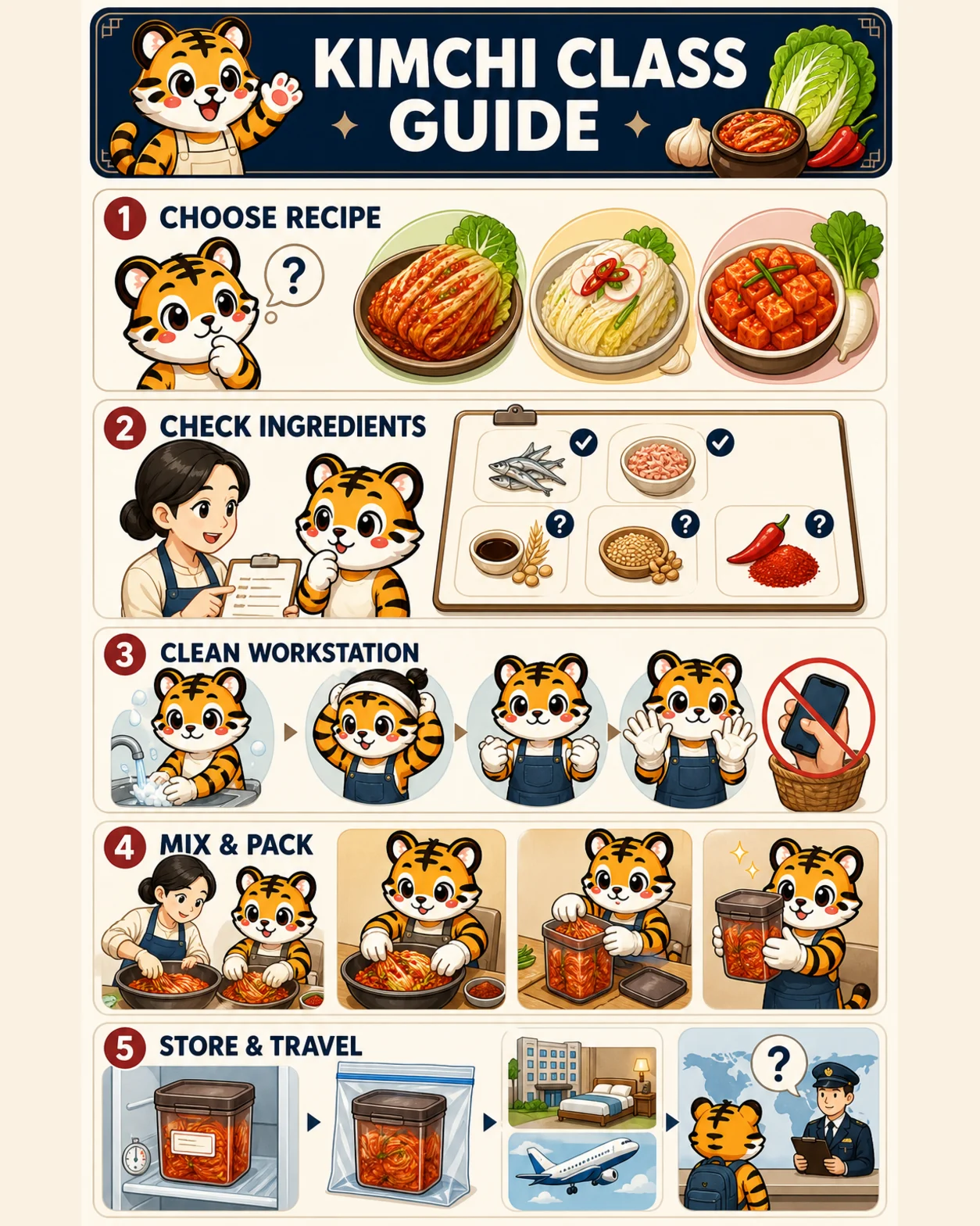
Skip to main content← All guidesA five-stage, hygiene-aware kimchi-class workflow; it does not depict a specific operator or prove that any recipe is vegan, allergen-safe or accepted for travel.Illustration: Korea Era editorial studio · Korea Era original editorial illustration
FOOD · GUIDE
Joining a Korean kimchi-making class
Book the exact recipe and language, disclose allergies before payment, confirm fish sauce, salted seafood and chili rather than assuming vegetarian or mild kimchi, follow the instructor's hygiene and fermentation directions, and take the finished container only after checking refrigeration, leak protection, accommodation, airline and destination-customs rules.
A live kimchi-making class or museum program listing→A completed class with the recipe understood and the finished kimchi stored or transported safely
USE IT ON THE TRIP
Keep this guide for the day you need it.
Add it to an itinerary, or ask travelers when one detail may have changed since the last official check.
Language, age and reservation are program-specific
LAST CHECKEDAugust 22, 202622 days ago. Fares, routes and final train times change—confirm live before you travel.
WHAT TO DO
Follow the trip in order.
Scan the essentials first. Open a step only when you need the detail.
Before ordering
1Choose the exact kimchi and class formatCheck whether the session makes whole-cabbage kimchi, white kimchi, radish kimchi or another recipe and whether it is a hands-on class, tasting, mu…
Check whether the session makes whole-cabbage kimchi, white kimchi, radish kimchi or another recipe and whether it is a hands-on class, tasting, museum activity or seasonal group kimjang. Confirm the take-home amount and whether every participant has a workstation.
2Confirm language, age and reservation separatelyRead the current date, start and end time, instruction language, minimum enrollment, child and guardian rule, accessibility, cancellation and late-…
Read the current date, start and end time, instruction language, minimum enrollment, child and guardian rule, accessibility, cancellation and late-arrival policy. Museum admission does not automatically reserve a class, and an old recurring schedule is not proof of today's session.
3Disclose allergies and dietary needs before payingAsk for the complete recipe and shared-equipment answer, including fish sauce, salted shrimp or other seafood, anchovy, soy, wheat, sesame, nuts, f…
Ask for the complete recipe and shared-equipment answer, including fish sauce, salted shrimp or other seafood, anchovy, soy, wheat, sesame, nuts, fruit, tomato and sweeteners. Request an alternative only when the operator can identify and separate it; do not assume white kimchi is vegan or allergen-safe.
Watch out A severe shellfish, fish or other food allergy deserves a direct operator answer before entering a shared kimchi workstation.
4Plan skin, spice and clothing comfortAsk how spicy the mixture is and whether a milder recipe exists.
Ask how spicy the mixture is and whether a milder recipe exists. Cover cuts as instructed, keep seasoning away from eyes, wear washable clothes and closed shoes, tie back hair and use the apron and food-safe gloves provided or approved by the class.
At the table
5Wash hands and keep the workstation cleanFollow the instructor's handwashing, glove-change, utensil and tasting rules.
Follow the instructor's handwashing, glove-change, utensil and tasting rules. Do not touch a phone, face, hair or personal bag with food gloves; change gloves and clean the area before returning to the ingredients.
Look for Kimchi experience 김치 체험 · Cooking class 요리 교실 · Hand washing 손 씻기
6Learn the recipe without reducing kimjang to one jarListen for why the vegetables are salted, how seasoning reaches between leaves and how the class stores the result.
Listen for why the vegetables are salted, how seasoning reaches between leaves and how the class stores the result. Understand kimjang as a living practice of making and sharing kimchi with regional and family variation, not one universally authentic recipe.
7Mix, pack and taste only as instructedUse the demonstrated portion and motion, keep raw ingredients within your workstation and pack the container without contaminating the rim.
Use the demonstrated portion and motion, keep raw ingredients within your workstation and pack the container without contaminating the rim. Taste only the provided ready-to-eat sample or when the instructor says the class product is safe to taste; do not sample from shared utensils.
If plans change
8Write the storage and fermentation instructions downSave the making date, kimchi type, ingredients, refrigeration instruction, venting or opening warning, recommended tasting window and use-by guidan…
Save the making date, kimchi type, ingredients, refrigeration instruction, venting or opening warning, recommended tasting window and use-by guidance supplied by the operator. Ask what to do if the container swells, leaks, smells abnormal or loses refrigeration.
9Verify the full route before taking it awayAsk the accommodation whether it permits kimchi in the room refrigerator, keep the sealed container upright in secondary leak protection and avoid…
Ask the accommodation whether it permits kimchi in the room refrigerator, keep the sealed container upright in secondary leak protection and avoid leaving it in heat. Check the carrier and destination customs or quarantine rules before packing it for any flight; ship, consume or leave it when entry is uncertain.
10Leave a dated and privacy-safe class updateSave the operator's Korean name, recipe, language and take-home result to your trip.
Save the operator's Korean name, recipe, language and take-home result to your trip. Afterward, share a dated update about reservation, allergens, accessibility or packaging without publishing another participant, recipe sheet or instructor demonstration without permission.
COMPARE OPTIONS
Choose without rereading the page.
Option
Best for
Cost
Watch out
Museum-linked kimchi class
Combining fermentation and kimjang context with a guided recipe.
Current admission and class fee as listed · Museum visit plus reserved session
Admission, class reservation, language and take-home product can be separate.
Independent cooking-studio class
A smaller group, meal pairing or a specific kimchi recipe.
Current class and ingredient fee · Published lesson
Verify operator identity, kitchen hygiene, language, recipe, cancellation and food handling before payment.
Seasonal festival or community kimjang
Experiencing the collective making and sharing context.
Current event fee or registration · Published event block
Dates, crowd format, take-home amount, allergens, weather and volunteer versus paid participation require a live event notice.
AVOID THESE MISTAKES
6 mistakes worth remembering.
Assuming kimchi is vegetarian because it is made from vegetables.
Do this instead Confirm fish sauce, salted seafood, stock and every recipe-specific ingredient.
Treating museum entry as a confirmed cooking-class seat.
Do this instead Book the exact date, recipe, language and participant separately.
Touching a phone with food gloves and returning to the cabbage.
Do this instead Remove or change gloves and wash as the instructor directs before resuming.
Tasting seasoning from a shared utensil.
Do this instead Taste only a designated ready-to-eat sample with a clean individual utensil.
Putting fresh kimchi in luggage because the class supplied a container.
Do this instead Confirm refrigeration, leak protection, airline carriage and destination customs first.
Calling one class recipe the only authentic kimchi.
Do this instead Record the recipe taught and respect regional, seasonal and household variation.
TRAVELER FAQ
Answers before you leave.
Is kimchi-making suitable for vegetarians or vegans?
Only when the exact class confirms an appropriate recipe and separated ingredients. Fish sauce and salted seafood are common, and white kimchi is not automatically vegan.
Can someone with a shellfish allergy join?
Ask the operator before paying. Shrimp paste or other seafood may be used and shared surfaces can create cross-contact. If the operator cannot confirm safe separation, choose a non-cooking museum visit or another activity.
Will the class be in English?
Only if the live listing or operator confirms it for your date. Museum audio support and cooking instruction are separate services.
Can children participate?
It depends on the exact program's age and guardian rule, tools, spice and workstation height. Confirm before booking rather than bringing an unregistered child.
Can I eat the kimchi immediately?
Follow the instructor's recipe-specific answer. Some samples are ready to taste, while your packed kimchi may be intended to ferment or refrigerate first.
Can I take homemade kimchi on a plane?
Do not assume so. Check the airline's liquid, leak and baggage rules and the destination country's food and quarantine rules. A sealed class container is not an import permit.
How should I store the container?
Use the operator's written refrigeration and fermentation instructions, keep it upright with secondary leak protection and ask the accommodation before using a shared or minibar refrigerator.
A practical Korean traditional-liquor class guide covering makgeolli and other formats, reservation and language, age and tasting, rice and nuruk allergens, sanitation, fermentation, pressure, storage, transport, customs and a dated brewery footprint.
A practical Korean menu decision guide for travelers who want serious heat and travelers who need a mild meal, with order phrases, adjustable choices, hidden broth risks and a fallback when the kitchen cannot change a prepared sauce.
Sources & verification4 official sources · August 22, 2026
Check it yourself.
Every changing rule stays attached to the organization responsible for it.
A safety-first food workflow for allergies, vegetarian, vegan, halal and other dietary needs, covering Korean labels, hidden stocks, cross-contact and emergency escalation.
A first traditional-market visit without payment surprises: choosing the right time, ordering a portion, asking about price and ingredients, carrying food, sorting waste and respecting working aisles and local shoppers.
A practical first visit to a Korean convenience store: choosing food, reading labels, heating a meal, handling waste, buying or reloading Tmoney and checking which services that exact branch provides.