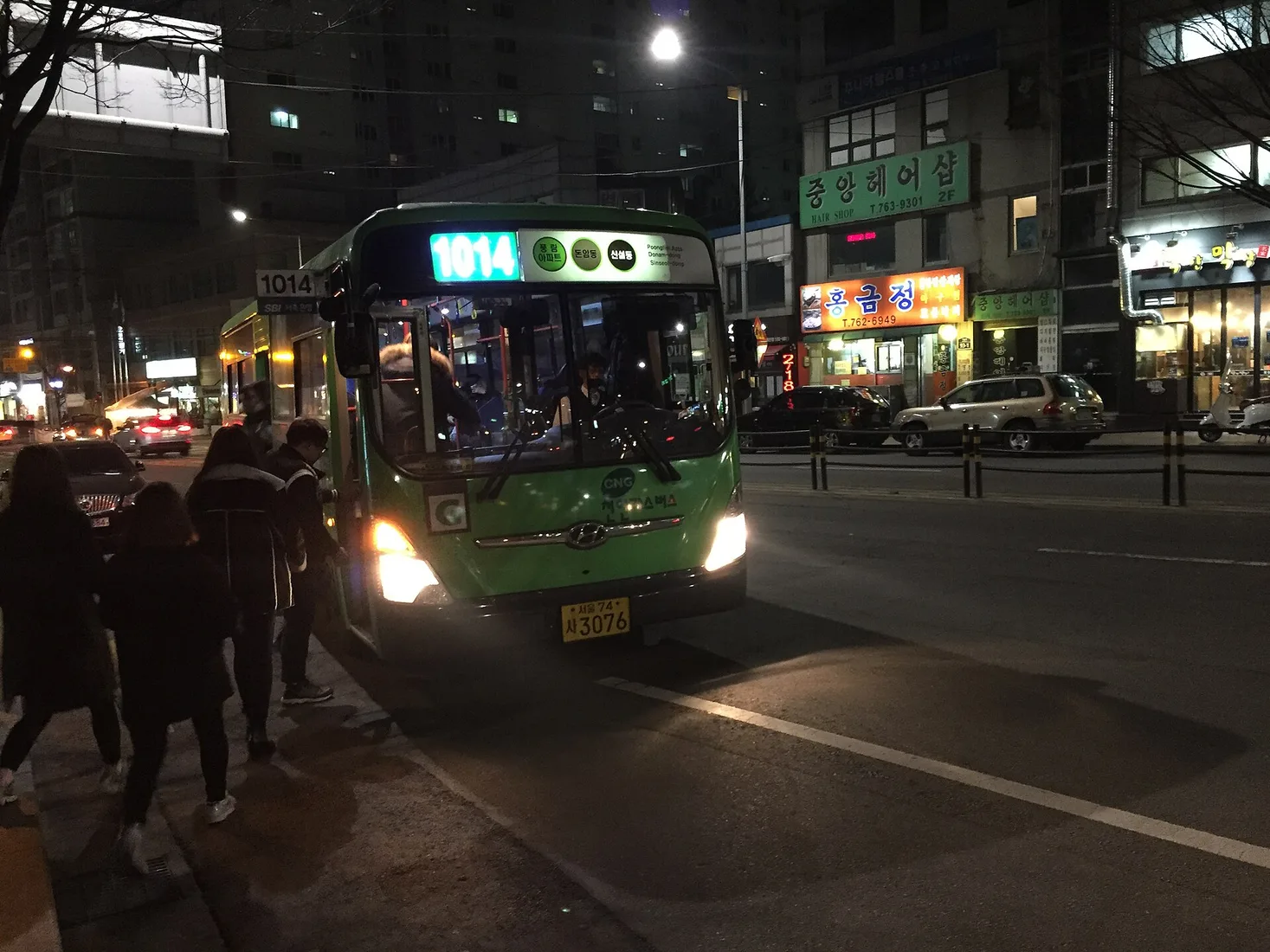
Skip to main content← All guidesA Seoul city bus at night. It is not a night-bus route; use it as a reminder to verify the live route number and final service.Photo: U2em · CC BY-SA 3.0 · resized
TRANSPORT · GUIDE
Using city buses across Korea
Check the route and live arrival in a Korean map app, board through the front door, tap a transit card when you enter and leave, and press the stop bell before your stop.
A Korean city bus stop→The correct stop without losing a transfer discount
USE IT ON THE TRIP
Keep this guide for the day you need it.
Add it to an itinerary, or ask travelers when one detail may have changed since the last official check.
LAST CHECKEDAugust 22, 202622 days ago. Fares, routes and final train times change—confirm live before you travel.
WHAT TO DO
Follow the trip in order.
Scan the essentials first. Open a step only when you need the detail.
Before boarding
1Search the exact stop and directionUse Naver Map or Kakao Map and match the route number, stop name and direction of travel.
Use Naver Map or Kakao Map and match the route number, stop name and direction of travel. Save the Korean stop name because opposite-direction stops can share a similar English name.
Watch out A route number alone is not enough; regional buses can reuse numbers and the stop across the road travels the other way.
2Check the live arrival and last useful busRead the current arrival estimate in the map app and check the full route before boarding.
Read the current arrival estimate in the map app and check the full route before boarding. In smaller cities and rural districts, gaps can be long and the final service can be early.
Look for 버스 · Bus
Watch out Treat a saved screenshot as a route reference, not a live timetable.
Start the trip
3Prepare a topped-up transit cardKeep a Tmoney, EZL or other locally accepted transit card ready before the bus arrives.
Keep a Tmoney, EZL or other locally accepted transit card ready before the bus arrives. Top-up methods and pass coverage differ, so keep a backup payment plan.
Watch out Do not assume the driver can sell a ticket or accept a foreign bank card.
4Board at the front and tap onceLet passengers leave, board through the front door on a standard city bus and place the transit card flat on the reader until it confirms the tap.
Let passengers leave, board through the front door on a standard city bus and place the transit card flat on the reader until it confirms the tap.
Look for 교통카드 · Card reader
Watch out If the reader rejects the card, step aside safely and ask the driver rather than tapping several cards at once.
During the trip
5Follow the route and request your stopTrack the vehicle in the map app, listen for the stop announcement and press a stop bell after the bus leaves the previous stop.
Track the vehicle in the map app, listen for the stop announcement and press a stop bell after the bus leaves the previous stop. Move toward the exit only when it is safe.
Look for 하차벨 · Stop button
6Tap off and verify the transferTap the same card on the rear-door reader as you leave.
Tap the same card on the rear-door reader as you leave. If transferring, follow the city-specific time and mode rules shown by the official operator rather than assuming one national window.
Watch out Missing the exit tap can affect the fare or an eligible transfer, especially on distance-based systems.
COMPARE OPTIONS
Choose without rereading the page.
Option
Best for
Cost
Watch out
Stored-value transit card
Most visitors taking ordinary buses and subways in several Korean cities.
Fare deducted per ride · Reusable across supported transit
Acceptance, top-up and refund rules vary by card, operator and location.
City or visitor transport pass
A dense itinerary inside the pass's exact coverage area.
Current pass price · Pass-specific period
Airport, express, regional and premium routes can be excluded.
Cash where explicitly accepted
A backup only after the operator confirms that the route accepts cash.
Local cash fare · One ride
Cashless city buses are expanding; never make cash the only boarding plan.
ILLUSTRATED GUIDES
See it step by step.
The same journeys drawn panel by panel, so you know what the next few minutes look like before you are standing in them.
Waiting at the stop with the right number in the wrong direction.
Do this instead Match the next stops and destination direction in a Korean map app.
Boarding without a usable transit card because cash worked in another city.
Do this instead Check the local operator and keep a topped-up accepted card ready.
Waiting until the bus reaches the stop before pressing the bell.
Do this instead Request the stop after leaving the previous one and prepare to exit safely.
Forgetting to tap when leaving.
Do this instead Use the same card on the exit reader to record the trip and any eligible transfer.
TRAVELER FAQ
Answers before you leave.
Do Korean city buses take cash?
Some still do, but cashless operation has expanded and differs by city and route. Use an accepted transit card as the dependable plan.
Which door do I use?
Most ordinary city buses use the front door for boarding and the rear door for exit. Follow the vehicle signage or driver when the layout differs.
Why do I need to tap when leaving?
It can calculate a distance-based fare and record an eligible transfer. The exact rule belongs to the city and operator.
How do I know where to get off?
Track the route in Naver Map or Kakao Map, save the Korean stop name and press the bell after the previous stop.
Are buses outside Seoul difficult to use?
The boarding action is similar, but intervals, last services, transfer rules and available live data vary. Check the regional operator and build a fallback before a remote trip.
How to reach Korean cities by long-distance bus: express versus intercity services, official booking sites, terminal matching, ticket collection, luggage and the return trip.
A foreign-traveler workflow for booking KTX and conventional trains, choosing the correct Seoul-area station, handling sold-out departures and deciding whether a KORAIL Pass is worth it.
A practical comparison of Tmoney, EZL, WOWPASS and Seoul's Climate Card, including where the boundaries are, why foreign cards are not a reliable top-up plan, and what to do before the last ride.
Sources & verification3 official sources · August 22, 2026
Check it yourself.
Every changing rule stays attached to the organization responsible for it.
An eight-step Seoul route workflow covering Korean place names, live directions, transit products, platform direction, taps, exits and elevators, bus stops, and late-night recovery.
How to choose between station lockers, Seoul T-Luggage storage and same-day delivery, with size checks, operating-hour limits, prohibited items and a safe handoff record.
A decision and pickup checklist for driving in Korea, including licence documents, insurance, tolls, navigation, parking, fuel, road rules and collision records.