CULTURE · EVERYDAY COURTESY
KOREA ERA · LIVE TRAVEL BOARDSeoul detail · events across Korea · Busan and Jeju city hubs

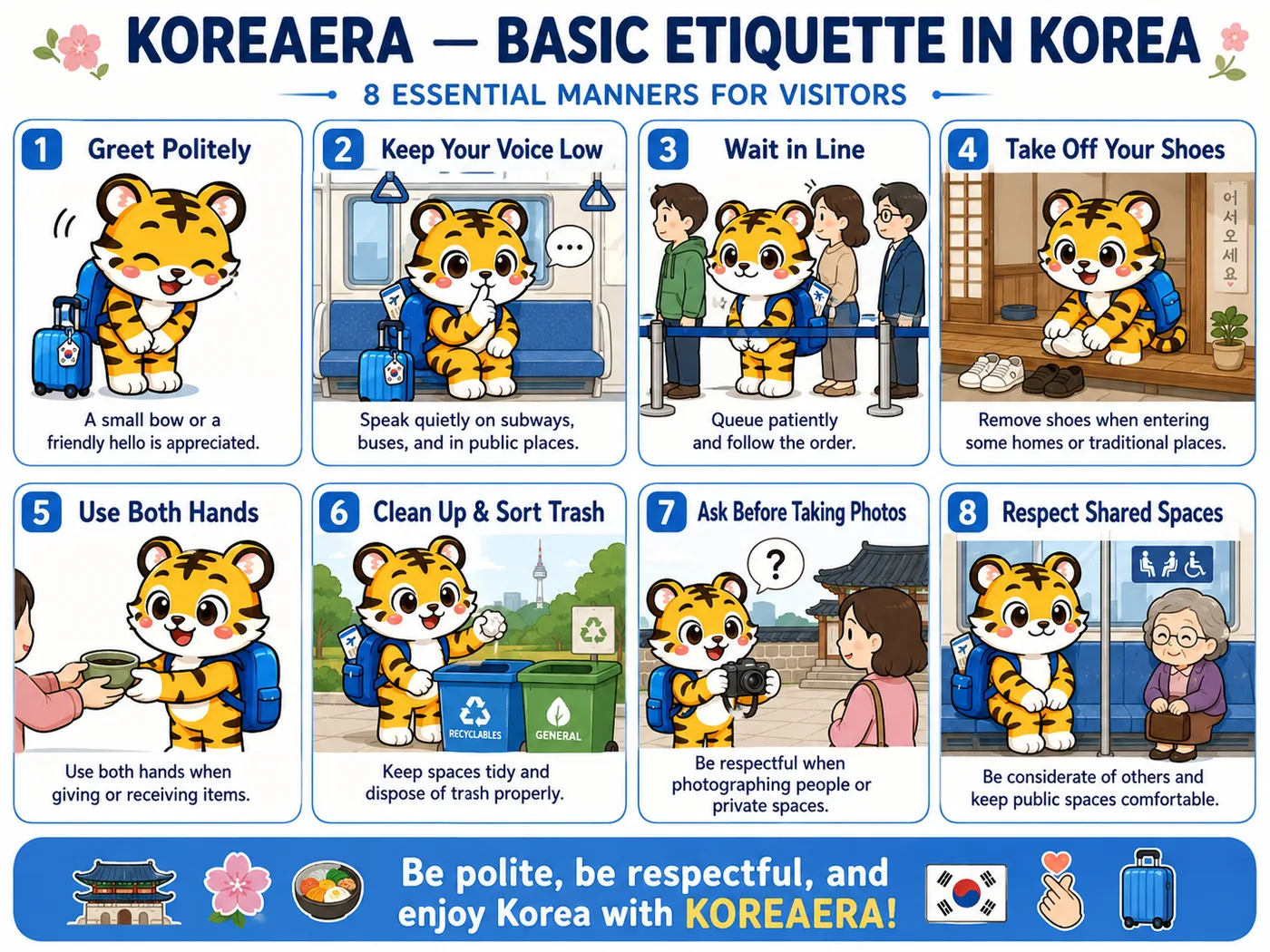
HOW TO USE THIS POSTER
Remember the moment. Read the context.
The image helps with recall; each card explains where the advice changes with the situation.- Moments
- 8
- Fact check
- 2026-08-21
- Daily prices or hours
- None
REAL HTML · ACCESSIBLE WITHOUT THE POSTER
Eight moments a first-time visitor can recognize.
Use the local instruction in front of you whenever it is more specific than this guide.- 01
Greet politely
정중하게 인사하기
A friendly hello and a small bow are safe, low-pressure ways to greet someone.A deep formal bow is not expected in every casual encounter. Follow the other person's level of formality. - 03
Wait in line
줄 서서 기다리기
Join the marked queue and let passengers leave before you board.Floor arrows and platform lines usually explain the local flow better than copying a crowd at the last second. - 04
Check whether shoes come off
신발을 벗는지 확인하기
Remove shoes in homes and wherever the entrance, host or floor layout asks you to.Some guesthouses, temples and floor-seating restaurants also ask. Do not assume every traditional-looking venue does. - 05
Use both hands in formal exchanges
두 손으로 주고받기
Using both hands to give or receive an item is a considerate default with elders and in formal situations.Everyday exchanges can be more relaxed. Treat this as a respectful option, not a test visitors are waiting to fail. - 06
Take care with trash
쓰레기 규칙 지키기
Use the bins and sorting labels provided; if there is no bin, carry your waste until you find one.Sorting rules vary by building and municipality, so the label at the bin is more useful than a universal color rule. - 07
Ask before photographing people
사진 촬영 전 허락 구하기
Ask before making a person the subject of a photo or recording inside a private space.Museums, temples, performances and security areas can have their own restrictions. Posted rules always take priority.
BEFORE YOUR FIRST DAY
Keep the refresher with your route.
Add one lightweight guide card—not eight fake places—to the trip you can edit.OFFICIAL CONTEXT