KOREA ERA · LIVE TRAVEL BOARDSeoul detail · events across Korea · Busan and Jeju city hubs
Korea Era

City day · TOPIC 197 / 200 · CHECKED 2026-08-21

Your second Korea trip should not be a longer first trip

첫 한국 여행과 두 번째 한국 여행은 이렇게 달라야 한다Use the first visit to learn the country’s operating basics. Use the return to stay longer in one region, travel in season, revisit one place and contribute a current memory instead of repeating a faster checklist.
A side-by-side brief that turns what worked, failed and stayed memorable on trip one into a deeper trip two.
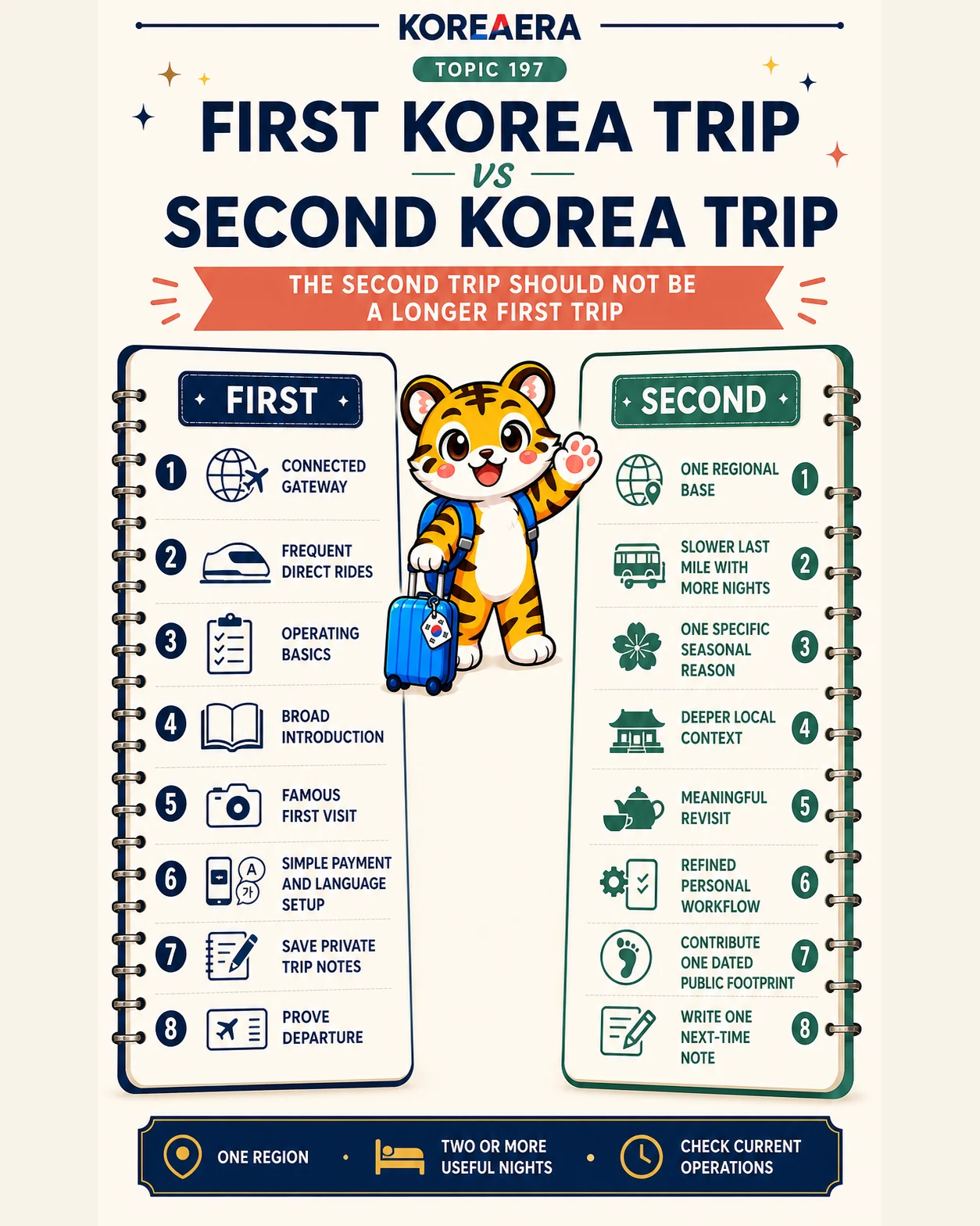
Korea Era tiger compares eight decisions for a connected first Korea trip and a slower regional return
Illustrated overview · live details and sources are listed below.
TIME
8 paired decisions · two different trip modes
BUDGET
Protect basics first · move spending toward depth later
BEST FOR
First-time planners · returning travelers · trip journals
MOVE
Frequent gateway first · one regional last mile on return

THE RETURN EDIT

8 trip decisions, each with a reason.

Compare the two columns as different operating modes. A second trip earns depth by using what the first trip taught you, not by collecting more distant pins.
01

01 · GEOGRAPHY

Learn one strong gateway, then choose one regional base

The first trip needs a forgiving operating system. The second can accept a less frequent last mile only when the base, nights and return are already solved.
  1. 01

    Build confidence from one connected base

    첫 여행 · 연결이 쉬운 한 곳

    Use Seoul or another well-connected arrival city to learn Korean addresses, transit cards, station exits, ordering and live navigation. Add at most one regional overnight when it has a clear gateway and enough time to deserve the move.

    Protect the arrival, room and departure before adding pinsA famous district is optional; a simple return to the accommodation is not
  2. 02

    Let one region become the trip, not a side quest

    두 번째 여행 · 한 지역에 오래 머물기

    Choose Busan, Jeju, Gangwon, Jeolla, Gyeongsang or central Korea because its food, landscape, event or people justify two or more nights. A direct international or domestic gateway can remove an unnecessary Seoul transfer when the live route fits.

    One base · two or more useful nightsSecond trip does not mean skip Seoul; it means Seoul is no longer compulsory
02

02 · PACE AND TRANSPORT

Use frequency to learn, then use time to go deeper

Regional depth is produced by fewer moves and more local time. It is not produced by drawing a wider national loop.
  1. 01

    Prefer direct rides, frequent service and visible exits

    첫 여행 · 직행 · 잦은 배차 · 쉬운 귀환

    Keep the first days operationally simple: one neighborhood cluster, one major intercity reservation at a time and a real airport buffer. This creates room to learn instead of spending the trip troubleshooting transfers.

    Pay for a useful location before an unlimited-looking passMap time excludes luggage, station depth, queues and the final walk
  2. 02

    Stay long enough for a rural or neighborhood last mile

    두 번째 여행 · 느린 연결을 감당할 체류시간

    Search the outbound and return together, then allow a bus gap, market morning, trail closure or weather swap. Choose one regional corridor and remove another city before relying on a fragile same-day chain.

    Spend nights to buy time, not taxis to rescue overpackingA rail ticket reaches a station, not the complete attraction day
03

03 · FOOD, CULTURE AND SEASON

Learn the grammar first, then follow one specific reason

The second trip becomes personal when it follows a season, craft, performance, ingredient or recurring place rather than a generic ‘hidden gem’ claim.
  1. 01

    Learn how Korea works through recognizable categories

    첫 여행 · 주문법과 기본 경험 익히기

    Try a complete Korean meal, one market, one public museum or heritage place and one contemporary neighborhood. Learn portion language, shared dishes, ingredients, payment and respectful visitor behavior before chasing novelty.

    One complete meal before a snack checklistFamiliar dishes still require vendor-specific allergen and ingredient checks
  2. 02

    Travel for one live regional reason

    두 번째 여행 · 계절 · 지역음식 · 공예 · 공연

    Anchor the return to a current festival, regional table, workshop, walking season or performance, then verify its official dates and rules before buying transport. Let nearby daily life fill the rest instead of scheduling another national landmark.

    One dated anchor + flexible surrounding daysA reel or old blog is inspiration, not proof that an event, stall or menu still operates
04

04 · MEMORY AND CONTRIBUTION

Save evidence on the first trip and return with context

A useful travel platform should remember more than likes. Constraints, dates, changes and respectful public-area reports make the next visit better for you and the next traveler.
  1. 01

    Record what actually happened, not the ideal itinerary

    첫 여행 · 실제 방문과 막힌 점 기록

    Save the Korean address, station exit, full price, wait, ingredient question, closure and transport lesson in Trips or Footprints. Keep live accommodation, passport, booking code and exact solo position private.

    Five useful facts beat fifty unsorted photosDate every operational claim so memory is not presented as live verification
  2. 02

    Revisit one place and leave one current, reproducible update

    두 번째 여행 · 재방문 · 최신 발자취 · 답변

    Return to one neighborhood, market or venue from trip one, notice what changed and add a dated footprint or answer a public question. Separate firsthand observation from official facts and disclose complimentary access or business relationships.

    One useful contribution, never a posting quotaDo not photograph faces, private homes, children or vendor workspaces without permission

YOUR NEXT-KOREA BRIEF

Turn the first trip into a better return.

Mark each decision when you know what to keep and what to change. Your return brief stays on this device.
Korea Era tiger mascot celebrating a completed route
0of 8 trip decisions
0%

01 · GEOGRAPHY

02 · PACE AND TRANSPORT

03 · FOOD, CULTURE AND SEASON

04 · MEMORY AND CONTRIBUTION

No account needed. This return brief is saved only in this browser.

COST CONTROL

Know what changes the total.

Use these as planning envelopes, then confirm live tickets, transport and accommodation before paying.
01

First-trip core

Gateway + basics

Protect arrival, accommodation, mobile data, frequent transport and the final departure before optional attractions.

02

First-trip learning

One of each

One complete meal, one market, one heritage or museum anchor and one contemporary neighborhood teach more than repeated categories.

03

Return-trip depth

Nights, not pins

Spend the extra capacity on a longer regional base, one dated experience and weather or closure flexibility.

04

Return-trip memory

Time, not admission

Revisit, compare and record a current detail without turning the holiday into unpaid content production.

TRIP BUDGETProtect basics first · move spending toward depth laterActual prices vary by date, operator, distance and personal choices.

EDITOR’S NOTES

The choices that make this edit work.

KEEP

Repeat what removed friction

Reuse the transit habits, Korean address format, payment fallback, packing system and departure buffer that worked. Familiar operations create room for new places.

Confidence is reusable
CHANGE

Replace breadth with one reason

Choose a region because of a season, person, event, craft, food or landscape. Then remove distant extras that dilute that reason.

One reason · one base
REVISIT

Return is not failure to discover

Seeing the same market in another season or greeting a familiar host can be more meaningful than a new pin. Revisit only with the same respect for privacy and space.

Notice what changed
CONTRIBUTE

Make memory useful without claiming authority

A dated firsthand wait, payment or access note can help. Official schedules, laws, safety controls and closures still belong to their responsible source.

Observation ≠ official fact

BEFORE YOU GO

What can still change

  • A first trip and a second trip are operating modes, not traveler ranks. A confident first-time visitor can go regional, and a returning visitor can choose Seoul again.
  • Do not add provinces simply because the trip is longer. Every hotel move consumes packing, check-out, station access, waiting, the last mile and check-in time.
  • Search intercity transport for the exact date and station. A fast rail segment does not prove a frequent local bus, open attraction or safe same-day return.
  • Direct international routes, seasonal flights, ferries, tourist buses and demand-responsive transit can change. Use the current operator or authority before building the trip around one.
  • Choose a second-trip season for a real reason, then keep a weather and cancellation fallback. Blossoms, foliage, snow, festivals and coastal conditions do not obey an old post's date.
  • Revisiting a place does not create permission to enter private alleys, photograph residents or behave like staff. Residential and religious etiquette applies every time.
  • Treat a community report as dated firsthand context. Official transport, venue, safety and entry sources remain authoritative for current decisions.
  • When leaving a Footprint, include visit date, public area, observed fact and uncertainty. Never expose accommodation, passport, booking code, children's identity or another traveler’s live position.
  • Disclose complimentary access, gifts, affiliate links or a business relationship. A useful return-trip note should not hide why it was posted.
  • For urgent police help call 112; for fire or ambulance call 119. Use 1330 for non-life-threatening multilingual travel information and tourism complaints.

USEFUL KOREAN

5 phrases for this edit

전에 왔을 때와 달라진 게 있어요?
Has anything changed since I visited before?
이 지역에서 이틀 머물 예정이에요.
I plan to stay in this area for two days.
오늘 마지막 버스는 몇 시예요?
What time is the last bus today?
사진을 찍어도 괜찮아요?
Is it okay to take a photo?
이 정보는 오늘도 맞아요?
Is this information still correct today?

CHECKED SOURCES

The illustration is not the source.

Changing facts are linked to the public body or tourism operator responsible for them.
  1. VisitKorea · destinationsOfficial nationwide region, city, attraction, restaurant, accommodation and event discovery starting point.Open official source ↗
  2. VisitKorea · travel plannerOfficial planning board covering Seoul and regional Korean cities; live details still need responsible-source checks.Open official source ↗
  3. VisitKorea · regional transport optionsCurrent official overview of city tours, tourist transport and demand-responsive options outside the simplest metro corridors.Open official source ↗
  4. KORAILOfficial current intercity rail search and booking source; station-to-attraction last miles remain separate.Open official source ↗
  5. Visit BusanOfficial Busan neighborhoods, food, events, guidebooks and current notices for a longer regional base.Open official source ↗
  6. Visit JejuOfficial Jeju attractions, food, stay, festivals, seasonal guidance and tourism inquiries.Open official source ↗
  7. VisitKorea · traditional marketsOfficial regional market discovery; individual vendor, market-day and night-market operations must be checked live.Open official source ↗
  8. Korea National Park ServiceOfficial park, trail, closure and safety entry point for a nature-led return trip.Open official source ↗
  9. TemplestayOfficial program search, reservation and temple-etiquette source for a specific cultural stay.Open official source ↗
  10. Visit Korean Heritage CampaignOfficial Korea Heritage Agency route and program entry point; local operating pages govern current admission and closures.Open official source ↗
  11. DurunubiOfficial Korea walking-route platform; use current route controls, weather and transport instead of an old GPX or post.Open official source ↗
  12. VisitKorea · 1330 helpline and complaint centerOfficial multilingual travel information, interpretation and tourism complaint channel.Open official source ↗

NEXT EDIT

Choose another kind of day.

3 nights · 4 daysSeoul in 3 nights and 4 real days3 nights · 4 calendar daysCity dayOne first day in Seoul without crossing the city twice1 day · suggested 09:00–20:00Budget dayA full Seoul day for ₩50,0001 day · 08:30–20:30