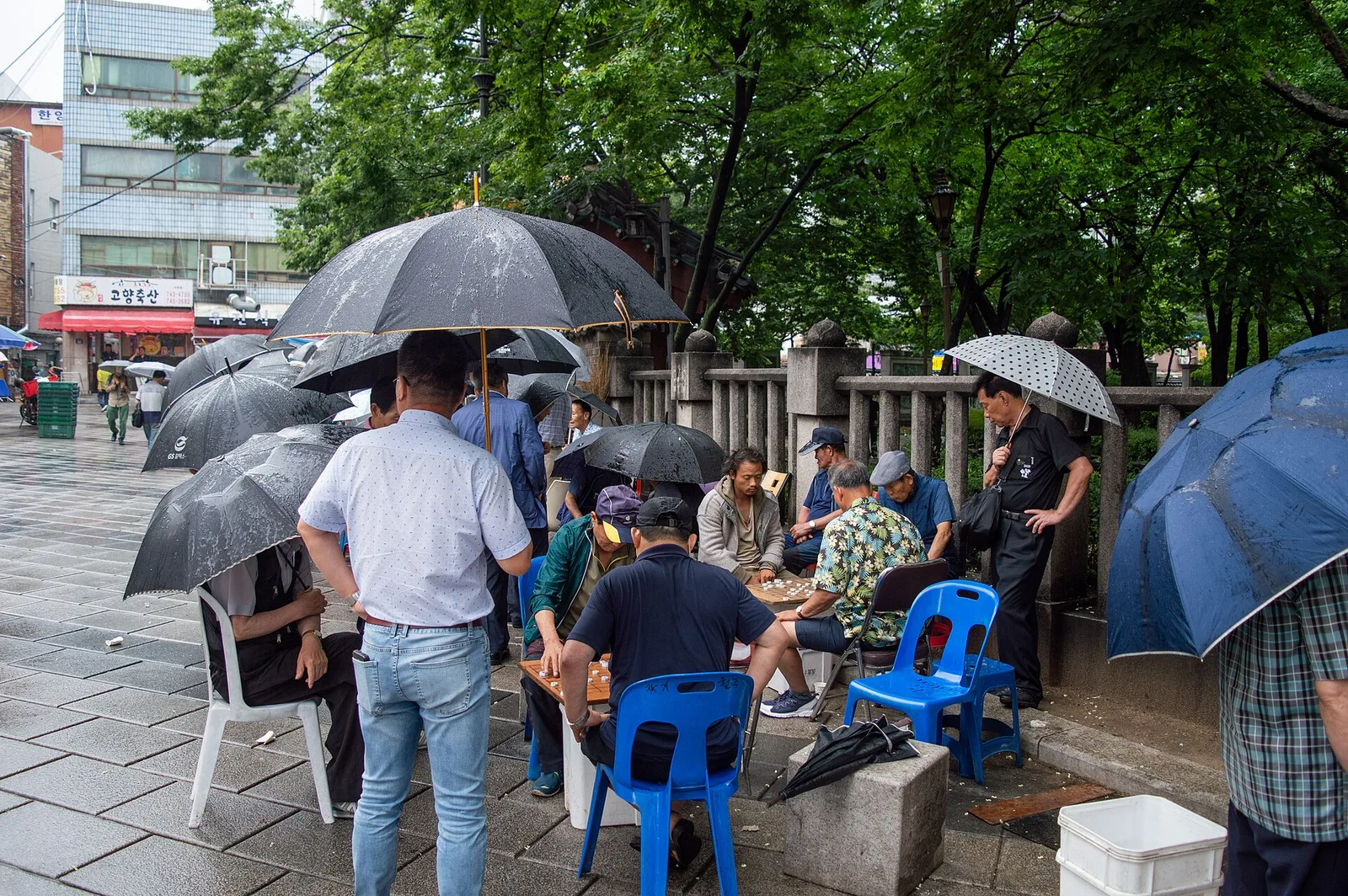
Skip to main content← All guidesRain beside Tapgol Park in Seoul. Heavy-rain alerts, flooded underpasses and transport notices require a live check.Photo: Tristan Surtel · CC BY-SA 4.0 · resized
SAFETY · GUIDE
A rainy day and heavy-rain alerts in Seoul
For ordinary rain, rebuild the day around one or two confirmed indoor stops; for a heavy-rain or flood alert, stop sightseeing, avoid streams, slopes, underpasses and flooded roads, and follow KMA and Seoul emergency instructions.
A Seoul itinerary when rain starts or an alert appears→A safe indoor route or shelter with the outdoor plan postponed
USE IT ON THE TRIP
Keep this guide for the day you need it.
Add it to an itinerary, or ask travelers when one detail may have changed since the last official check.
LAST CHECKEDAugust 22, 202622 days ago. Fares, routes and final train times change—confirm live before you travel.
WHAT TO DO
Follow the trip in order.
Scan the essentials first. Open a step only when you need the detail.
Prepare
1Decide whether this is rain or a safety eventOpen the Korea Meteorological Administration warning map and the current Seoul safety notice.
Open the Korea Meteorological Administration warning map and the current Seoul safety notice. Ordinary rain calls for an indoor route; a heavy-rain, flood, landslide or evacuation warning overrides the itinerary.
Watch out A phone weather icon does not replace an official district-level warning.
2Cancel the exposed parts firstRemove stream walks, riverside paths, mountain routes, basement venues, low underpasses and long outdoor transfers.
Remove stream walks, riverside paths, mountain routes, basement venues, low underpasses and long outdoor transfers. Follow police, station and facility closures even if a map still shows the route as open.
Act now
3Choose one indoor area, not a citywide checklistPick one museum, mall, market hall or cultural facility with confirmed opening hours, then add a nearby meal.
Pick one museum, mall, market hall or cultural facility with confirmed opening hours, then add a nearby meal. Keep transfers short and verify that the entrance is not through a flooded or closed approach.
4Protect the return routeCheck the final train or bus before entering a long exhibition, keep the accommodation address in Korean, and save a taxi fallback.
Check the final train or bus before entering a long exhibition, keep the accommodation address in Korean, and save a taxi fallback. Service can slow or divert during severe weather.
Follow up
5Move to higher, staffed space if water is risingDo not enter flowing water, a flooded underpass or an underground parking area.
Do not enter flowing water, a flooded underpass or an underground parking area. Leave the vehicle if authorities instruct you to evacuate and move to higher ground or the directed shelter.
Look for 호우 · 홍수 · 통제 · 대피
6Use official help instead of guessingCall 119 for immediate danger.
Call 119 for immediate danger. For non-emergency travel interpretation or help finding current official information, use the Korea Travel Helpline at 1330.
COMPARE OPTIONS
Choose without rereading the page.
Option
Best for
Cost
Watch out
Compact indoor day
Ordinary rain with no local safety alert.
Venue and local transport costs · Half or full day
Confirm opening, reservation and the actual entrance route before leaving.
Wait and reroute
A safe staffed building while transport and rain are changing quickly.
Usually no added cost · Until the warning or intense cell passes
Do not wait in a basement, streamside structure or vehicle in a flooding area.
End the sightseeing day
Official heavy-rain, flood, landslide or evacuation instructions.
Transport back to safe accommodation · Immediate
A prepaid booking is never a reason to ignore a closure or emergency alert.
AVOID THESE MISTAKES
4 mistakes worth remembering.
Treating every rainy day as harmless.
Do this instead Check the official warning and local closures before choosing an indoor plan.
Using an underground shortcut through visible water.
Do this instead Turn around, move to higher ground and follow official control lines.
Crossing Seoul between many indoor attractions.
Do this instead Cluster one or two verified stops and protect the return journey.
Following a saved route after a closure alert.
Do this instead Use current operator and city notices; map routing can lag behind controls.
TRAVELER FAQ
Answers before you leave.
Is Seoul safe to visit when it rains?
Ordinary rain can be handled with a compact indoor plan. Heavy-rain, flood or evacuation alerts require a safety plan instead of sightseeing.
Can I walk along Cheonggyecheon or the Han River in heavy rain?
Do not enter a stream, riverside path or other controlled area when it is closed or a flood risk exists. Follow barriers and city instructions.
What should I do if a road or underpass is flooded?
Do not walk or drive into it. Turn back, move to higher ground and call 119 if anyone is in immediate danger.
Where can I get travel help in English?
The Korea Travel Helpline 1330 provides travel information and interpretation. Use 119, not 1330, for immediate rescue or medical danger.
Will museums and shops remain open?
Some will, but hours, reservations, weather closures and access routes differ. Confirm the exact venue on its official page before travelling.
A winter safety workflow for Seoul covering cold-wave checks, icy pavements, snow disruption, warm indoor stops, clothing, transport fallbacks and urgent warning signs.
A practical Seoul heatwave schedule with official risk checks, shaded transfers, cooling breaks, hydration, climate shelters and clear escalation for heat illness.
A coast-specific safety workflow for beaches, rocks, breakwaters, mudflats and water activities that treats lifeguards, barriers, weather and local controls as live conditions rather than scenery.
Sources & verification3 official sources · August 22, 2026
Check it yourself.
Every changing rule stays attached to the organization responsible for it.
A traveler-safe path through Korean pharmacies, clinics, hospitals and emergency care, including interpretation, medication records, bills and travel-insurance evidence.
A recoverable sequence for property lost in Korean taxis, transit, venues or streets, with Lost112 search, police reporting, phone protection, insurance evidence and passport replacement.