KOREA ERA · LIVE TRAVEL BOARDSeoul detail · events across Korea · Busan and Jeju city hubs
Korea Era

Food trail · TOPIC 42 / 200 · CHECKED 2026-08-22

Seven Daegu foods — choose two or three, ask before you order

대구에서 꼭 먹어야 하는 음식 7가지A practical seven-dish edit of Daegu's official Ten Tastes: three full meals, one grill, one raw-beef choice, one thin dumpling snack and one chilli-dressed seafood plate — with the ingredient question attached to every order.
Pick two or three across the trip, understand what is actually in the dish and confirm the portion and final total before the kitchen starts.
Explore the 7 foods ↓
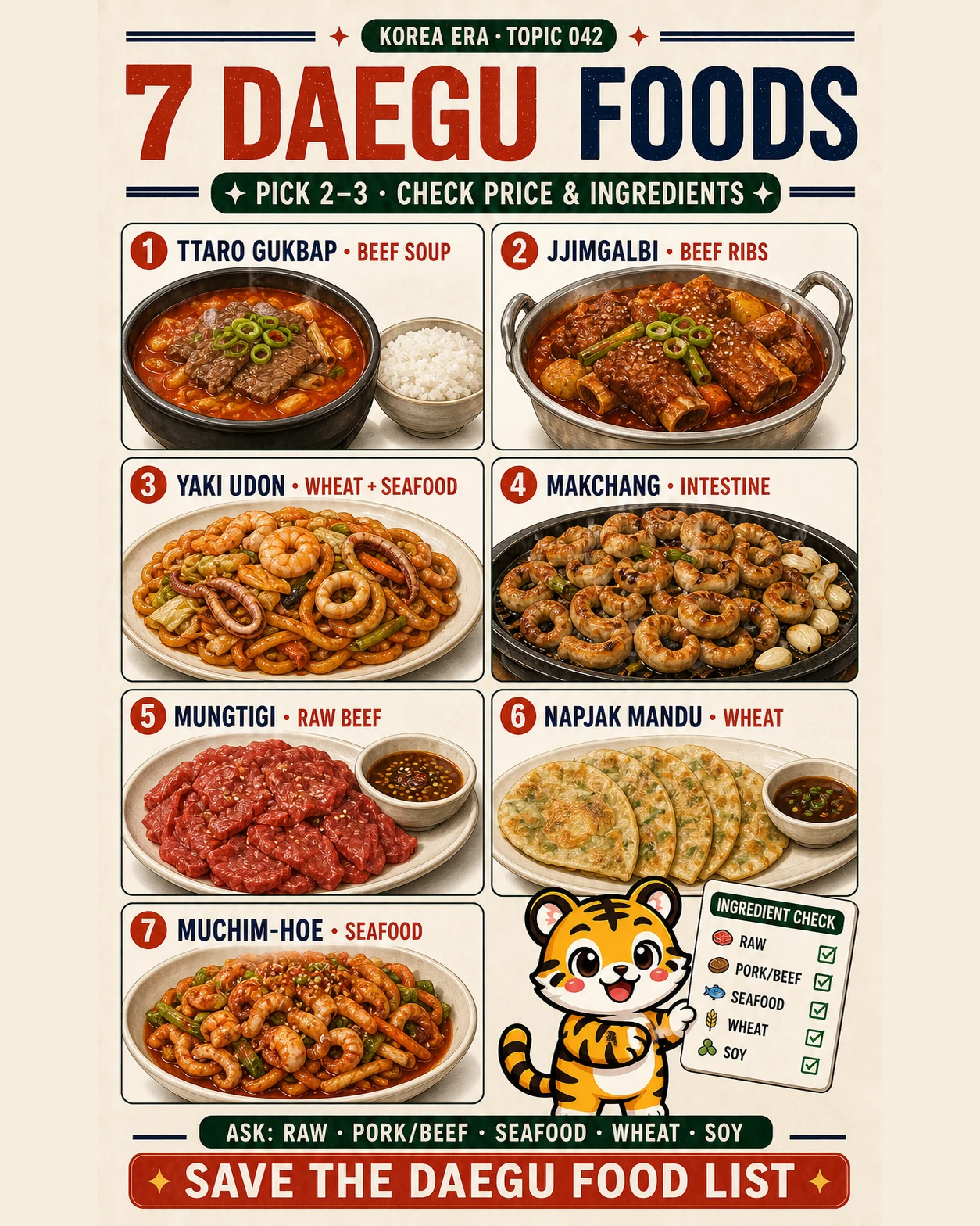
Korea Era tiger holding an ingredient checklist beside seven numbered Daegu food panels
Illustrated overview · live details and sources are listed below.
TIME
7 choices · pick 2–3 across the trip
BUDGET
Posted menu + portion + minimum order + extras + final total
BEST FOR
First Daegu trip · food history · ingredient-aware diners
MOVE
Choose food near the district already in your day; this is not one seven-stop route

THE FOOD EDIT

7 foods, each with a reason.

The groups help you choose. They are not a challenge to eat every dish or cross the city in order.
01

FULL MEALS · CHOOSE ONE

Soup, ribs or stir-fried noodles tell three different Daegu stories

All three can be spicy and none has one universal recipe. Pick the meal that fits the diner, then ask about broth, meat, seafood, wheat, soy and the restaurant's minimum order.
  1. 01

    Ttaro gukbap

    따로국밥 · 대구육개장

    Daegu's red beef soup is served with rice in a separate bowl — the 'ttaro' idea — rather than promising one fixed garnish or spice level. Ask whether the broth contains beef bone, meat, seonji or another ingredient you avoid.

    Usually one-person meal · confirm today's menu, rice inclusion and final priceBeef and beef-bone broth are common; seonji (coagulated ox blood), chilli, garlic, soy, wheat or shared preparation can vary
  2. 02

    Dongin-dong jjimgalbi

    동인동찜갈비

    This Daegu style uses beef ribs, red chilli and plenty of garlic in a metal pot, distinct from a mild soy-braised galbijjim. State the preferred heat level before cooking and handle the pot and rib bones carefully.

    Often shared · confirm per-person or per-pot pricing, minimum diners, rice and extra chargesBeef, garlic and chilli; sauces or side dishes can add soy, wheat, sesame, fish or shellfish ingredients
  3. 03

    Daegu-style yaki udon

    대구식 야끼우동

    Despite the borrowed name, Daegu's version is a local spicy, brothless stir-fry developed around wheat udon, vegetables and a high-heat wok. The classic city description includes shrimp, squid and pork, so a vegetable-looking plate is not automatically vegetarian.

    Usually one plate · confirm heat level, seafood, pork, portion and whether rice or sides cost extraWheat, shrimp, squid, pork and soy are common; egg, sesame, oyster sauce and shared-wok cross-contact can vary
02

GRILL OR RAW · CHOOSE ONE

Decide the animal, cooking level and table size before sitting down

Makchang is an organ-meat grill; mungtigi is raw beef. Neither is a compulsory rite of passage, and a cooked alternative is the better choice whenever raw food does not suit the diner.
  1. 01

    Makchang gui

    막창구이

    Daegu's grill culture made chewy, browned makchang a signature, but the word can refer to beef or pork intestine depending on the business. Ask which animal, how much the first order must be and who finishes the grilling.

    Commonly shared and subject to a minimum first order · confirm weight, animal, extras and final totalBeef or pork offal; dipping paste and marinades may contain soy, wheat, sesame, chilli, garlic or shared-grill cross-contact
  2. 02

    Mungtigi

    뭉티기 · 생고기

    Thick pieces of unseasoned raw beef are dipped in a sesame-oil, garlic and chilli sauce. Supply can be limited by freshness, delivery or the day of the week; no saved post proves it is available or appropriate for every traveler.

    Often a shared plate · ask availability, cut, serving size and displayed total before orderingRaw beef carries foodborne-illness risk; sauce can contain sesame, soy or chilli, and raw-meat preparation can cross-contact other foods
03

SNACK OR SEAFOOD · CHOOSE ONE

A thin dumpling or a chilli-dressed seafood plate

Napjak mandu is the easy small-format choice. Muchim-hoe is a seafood dish whose species and cooking state must be asked, not guessed from the English word 'hoe'.
  1. 01

    Napjak mandu

    납작만두

    Daegu's very thin half-moon dumpling uses a restrained glass-noodle and vegetable filling, then is boiled and pan-grilled. It can be eaten with scallion and soy or paired with spicy food, but that simple appearance is not an allergen guarantee.

    Small plate or market snack · confirm quantity, sauce, topping and displayed totalThe wrapper contains wheat; filling, soy sauce, shared griddle and optional tteokbokki can add soy, sesame, meat, fish, egg or other cross-contact
  2. 02

    Muchim-hoe

    무침회

    Daegu's spicy dressed seafood developed in an inland-city context and can mix squid, whelk or other molluscs, vegetables and chilli seasoning; some traditional descriptions also include raw eel. Ask today's exact species and which items are raw, blanched or cooked.

    Often shared · confirm species, serving size, rice or noodles, extras and final totalFish or molluscan shellfish with chilli seasoning; soy, wheat, sesame, garlic and seafood cross-contact are possible

YOUR TASTE LIST

Keep a personal Busan food log.

Mark each food after you try it. Your list stays on this device.
Korea Era tiger mascot celebrating a completed route
0of 7 foods
0%

FULL MEALS · CHOOSE ONE

GRILL OR RAW · CHOOSE ONE

SNACK OR SEAFOOD · CHOOSE ONE

No account needed. This taste list is saved only in this browser.

EDITOR’S NOTES

The choices that make this edit work.

SEVEN OF TEN

An editorial shortlist, not a ranking

Daegu officially presents ten representative tastes. This guide selects seven for a first trip and leaves nureun guksu, nonmegi maeuntang and pufferfish bulgogi for another visit; 'missing' does not mean inferior.

Seven useful doors into a ten-dish system
FIRST PAIR

One meal + one small or shared plate

Start with ttaro gukbap, jjimgalbi or yaki udon, then add napjak mandu, makchang or muchim-hoe only if appetite, ingredients and table size work. Mungtigi remains an optional raw-food decision.

Two informed choices beat seven rushed bites
RAW DECISION

Mungtigi is never mandatory

Raw beef brings a different foodborne-illness risk. Pregnant, elderly, immunocompromised or otherwise high-risk diners should seek appropriate medical advice and choose thoroughly cooked food when raw meat is unsuitable.

Freshness language does not remove raw-food risk
ORDER RULE

Repeat the final total first

Ask animal or seafood species, portion or weight, minimum first order, rice, cooking or preparation charge, alcohol and final total. A guidebook photo is not today's bill.

Menu · portion · extras · total

BEFORE YOU GO

What can still change

  • These are seven alternatives, not an eat-all challenge, ranking or one-day restaurant route. Choose two or three across the trip and attach each to the neighborhood already in the day's plan.
  • Daegu Metropolitan City officially defines ten representative tastes, first designated in 2006. This editorial seven omits nureun guksu, nonmegi maeuntang and pufferfish bulgogi for space and first-trip practicality; omission is not a quality judgment.
  • The city's July 2026 restaurant guide is a current discovery source, not a permanent endorsement or reservation. Every business sets its own menu, hours, holidays, price, portion, minimum order, card policy and ingredient practice, so verify the chosen restaurant directly.
  • Ttaro gukbap means the rice and soup are served separately, but recipes vary. Beef meat or bone broth is common and some bowls can include seonji, so ask explicitly rather than assuming every red soup has the same ingredients.
  • Dongin-dong jjimgalbi is spicy beef short rib with garlic and chilli, commonly served in a hot metal pot. Confirm the heat level before cooking, check whether an order is per person or per pot and watch for bones and hot handles.
  • Daegu-style yaki udon is a spicy, brothless local stir-fry rather than a promise of a Japanese recipe. The official city description includes wheat noodles, shrimp, squid, pork and vegetables; ask about soy, oyster sauce, egg and shared-wok cross-contact too.
  • Makchang is animal intestine, not a generic boneless barbecue. Confirm beef or pork, raw weight or portion, minimum first order, who controls the grill and whether the center is fully cooked before eating.
  • Mungtigi is raw beef, not lightly cooked steak. Freshness or same-day supply does not eliminate foodborne-illness risk, and availability can be limited; choose a thoroughly cooked alternative when raw meat is unsuitable and do not pressure another diner to try it.
  • Napjak mandu has a wheat wrapper and a sparse glass-noodle or vegetable filling. It is not automatically gluten-free, vegan or allergen-free because sauces, fillings, toppings, shared griddles and nearby tteokbokki preparation differ by shop.
  • Muchim-hoe is not necessarily a plate of raw fish slices. Daegu's traditional description names blanched squid, whelk or freshwater snail and sometimes raw eel with vegetables and seasoning; ask the exact species and whether each seafood item is raw, blanched or fully cooked.
  • A severe allergy cannot be solved by removing a visible garnish. Show a written Korean ingredient and cross-contact request before ordering, leave when the kitchen cannot confirm it and carry prescribed emergency medication according to medical advice.
  • Vegetable-heavy presentation does not prove vegetarian, vegan, halal or kosher suitability. Beef broth, pork, blood, seafood, fish sauce, oyster sauce, shared grill or wok and alcohol-based seasoning can be invisible.
  • Alcohol is optional and never required to understand Daegu food culture. Ask for water or a non-alcoholic drink, and never drive after drinking.
  • The Daegu food-safety page advises thorough cooking and lists separate minimum core-temperature guidance for food and seafood. Travelers cannot validate a restaurant by appearance alone; if food seems undercooked, stop and ask rather than continuing for the camera.
  • For abdominal pain, vomiting or diarrhea after eating, the city's food-poisoning response page advises visiting a medical facility and following professional instructions. Call 119 for an urgent medical emergency and 1330 for multilingual travel support; call 112 for police.
  • Food-safety, safe-restaurant or hygiene-designation lists can help discovery, but a listing is not an allergen guarantee, raw-food recommendation or proof of today's status. Check the current listing and the restaurant directly.
  • Ask before filming staff, other diners, grilling tables or a kitchen. Keep aisles and hot tabletop grills clear, supervise children near flames and do not block a small business to recreate a campaign frame.

USEFUL KOREAN

6 phrases for this edit

이 음식에 소고기, 돼지고기나 선지가 들어가요?
Does this contain beef, pork or coagulated blood?
생고기 말고 완전히 익힌 음식이 필요해요.
I need fully cooked food, not raw meat.
새우, 오징어나 조개류가 들어가요?
Does this contain shrimp, squid or shellfish?
밀, 콩이나 참깨가 들어가요?
Does this contain wheat, soy or sesame?
최소 주문량과 최종 가격이 얼마예요?
What is the minimum order and final price?
이 해산물은 생것이에요, 익힌 것이에요?
Is this seafood raw or cooked?

CHECKED SOURCES

The illustration is not the source.

Changing facts are linked to the public body or tourism operator responsible for them.
  1. Daegu Food · 2026 restaurant guide noticePrimary July 2026 city guide notice and current Ten Tastes, long-running restaurant and food-alley context.Open official source ↗
  2. Daegu Food · official Ten Tastes overviewPrimary list, 2006 designation and explanation that the system includes meals, drinking foods and a snack.Open official source ↗
  3. Daegu Food · English Ten TastesOfficial English names and descriptions for international visitors.Open official source ↗
  4. Daegu Tourism · Ten TastesOfficial city history, food-alley and dish descriptions; individual businesses still require live checks.Open official source ↗
  5. Daegu Food · ttaro gukbapPrimary red beef-soup, separate-rice and current restaurant-discovery context.Open official source ↗
  6. VISITKOREA · ttaro gukbapOfficial English description of the separate rice and spicy Daegu beef soup.Open official source ↗
  7. Daegu Food · Dongin-dong jjimgalbiPrimary beef-rib, chilli, garlic, metal-pot and district context.Open official source ↗
  8. Daegu Food · makchang guiPrimary intestine-grill history and current restaurant-discovery page.Open official source ↗
  9. Daegu Food · mungtigiPrimary raw-beef definition, cut and city context.Open official source ↗
  10. VISITKOREA · mungtigiOfficial English raw-beef and freshness context; not a medical safety endorsement.Open official source ↗
  11. Daegu Food · yaki udonPrimary local stir-fry history and classic wheat, seafood, pork and vegetable ingredients.Open official source ↗
  12. Daegu Food · napjak manduPrimary thin-wrapper, sparse-filling and pan-finished dumpling description.Open official source ↗
  13. Daegu Food · muchim-hoePrimary inland-city seafood, species, cooking-state and Bangogae alley context.Open official source ↗
  14. Daegu Food · food-poisoning preventionPrimary city handwashing, thorough-cooking and boiling-water guidance.Open official source ↗
  15. Daegu Food · food-poisoning responsePrimary city guidance to seek medical care for abdominal pain, vomiting or diarrhea.Open official source ↗
  16. Food Safety Korea · definition and hazardsMinistry of Food and Drug Safety classification including microbial and natural-toxin food poisoning.Open official source ↗
  17. Food Safety Korea · cooking and storageOfficial core-temperature and storage guidance; not a way for diners to certify a restaurant.Open official source ↗
  18. Daegu Food · food-safe establishmentsCurrent city hygiene-discovery list; designation is not an allergen or raw-food guarantee.Open official source ↗
  19. Daegu Food · safe restaurantsCurrent city safe-restaurant discovery page; recheck status and the chosen kitchen directly.Open official source ↗
  20. VISITKOREA · 2026 Daegu culinary tripCurrent official English context for makchang, jjimgalbi, napjak mandu, Seomun Market and food alleys.Open official source ↗
  21. Daegu Tourism · food and transport gatewayOfficial city food overview and visitor discovery gateway.Open official source ↗
  22. Korea Tourism Organization · 1330Official multilingual travel helpline and emergency-support context.Open official source ↗

NEXT EDIT

Choose another kind of day.

3 nights · 4 daysSeoul in 3 nights and 4 real days3 nights · 4 calendar daysCity dayOne first day in Seoul without crossing the city twice1 day · suggested 09:00–20:00Budget dayA full Seoul day for ₩50,0001 day · 08:30–20:30