KOREA ERA · LIVE TRAVEL BOARDSeoul detail · events across Korea · Busan and Jeju city hubs
Korea Era

Heritage day · TOPIC 45 / 200 · CHECKED 2026-08-22

How to time-travel to Silla in Gyeongju

경주에서 신라시대로 시간여행하기Use six pieces of evidence — tomb landscape, gold, astronomy, palace archaeology, pond finds and Buddhist stonework — to read Gyeongju as a capital rather than photograph it as one old-looking backdrop.
A Silla field guide, not another fixed route: look for one real clue, read the museum or site interpretation, verify what is known and leave the heritage undisturbed.
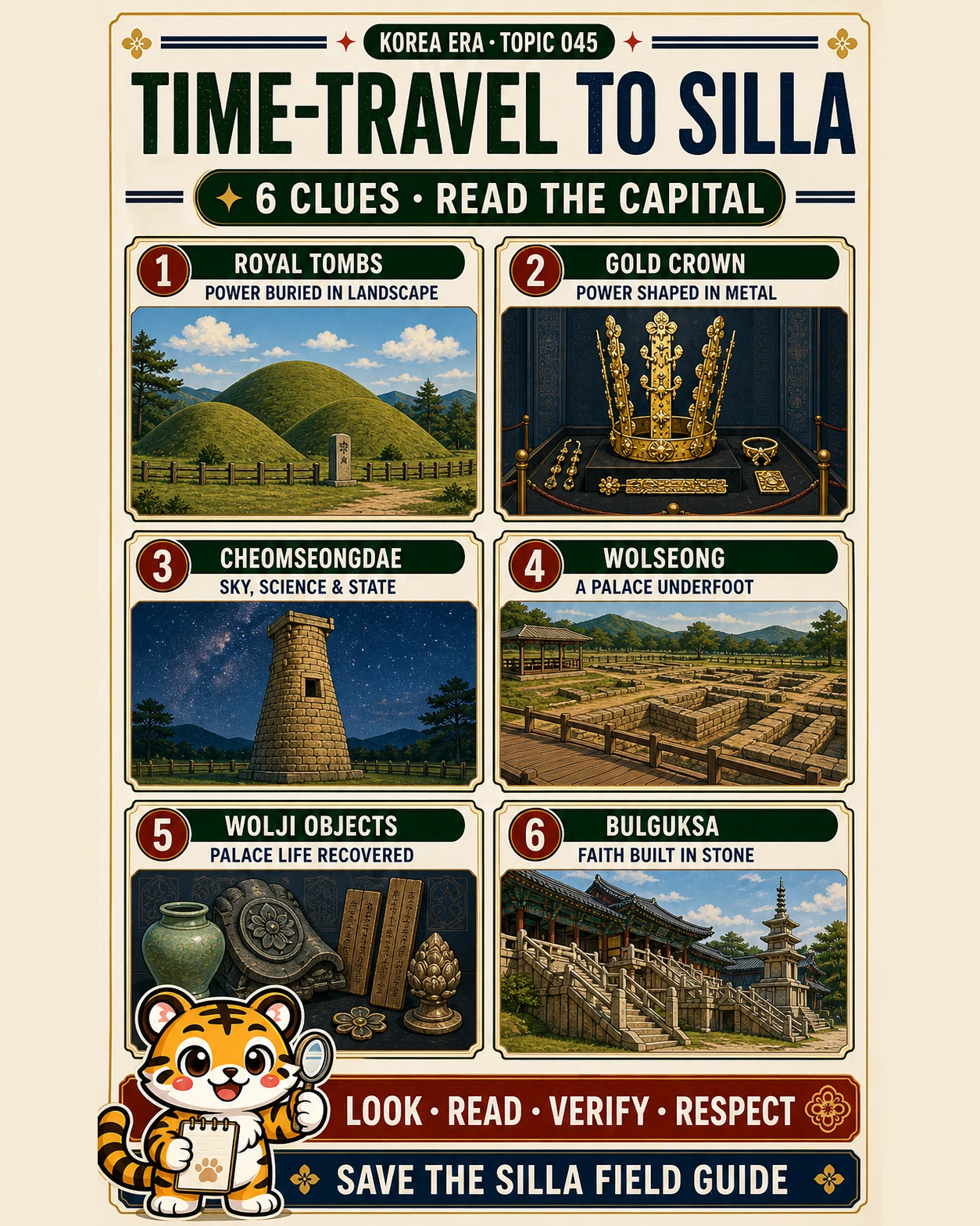
Korea Era Silla field-guide poster with six evidence cards for royal tombs, a gold crown, Cheomseongdae, Wolseong archaeology, Wolji objects and Bulguksa
Topic 045 · Six ways to read Silla evidence without turning history into costume scenery.
TIME
6 evidence lenses · choose 2–4 for one day or collect them across the trip
BUDGET
Mostly observation · museum general admission currently free · site-specific admission and interpretation vary
BEST FOR
Curious first visitors · families with older children · repeat Gyeongju travelers
MOVE
Attach clues to the route already booked; this is not a cross-city checklist

THE EXPERIENCE EDIT

6 experiences, each with a reason.

These are alternatives, not one eight-stop day. Choose two or three that fit one district, your booking status and the live conditions.
01

POWER · KNOWLEDGE · LANDSCAPE

Read what the capital placed above and below ground

These are three independent lenses. Pair the tomb landscape with a museum gallery, or add Cheomseongdae to a central walk; no visitor needs to complete all three in one session.
  1. 01

    Royal tombs — power buried in landscape

    왕릉 · 대릉원

    Compare mound shape, scale, grouping and protected space before entering optional Cheonmachong. UNESCO describes the Tumuli Park Belt as royal-tomb groups whose excavations revealed gold, glass and ceramics; the visible grass form is only the outer layer of that evidence.

    Daereungwon park currently free · Cheonmachong separately paid · verify live admission
  2. 02

    Gold crown — power shaped in metal

    신라 금관 · 국립경주박물관

    Read a crown through material, joining, suspended ornaments, findspot and museum label rather than using 'golden kingdom' as a fantasy slogan. The museum's permanent Silla History Gallery connects goldwork to the emergence, authority and wider culture of Silla.

    Museum general admission currently free · gallery closures and special exhibitions can differ
  3. 03

    Cheomseongdae — sky, science and state

    첨성대

    Look at the stone cylinder, square base, upper opening and its relationship to the royal district. Treat modern symbolic readings as interpretation, not a license to claim that every stone count or star story has one uncontested meaning.

    Grounds currently listed free · events and interpretation operate separately
02

PALACE · DAILY LIFE · FAITH

Move from excavated foundations to objects and built belief

Wolseong and Wolji objects work best as a site-and-museum pair. Bulguksa expands the story into Unified Silla Buddhist architecture, but remains an active temple rather than an exhibition set.
  1. 01

    Wolseong — a palace underfoot

    월성 발굴현장

    Use the official observation point to read foundation traces, moat, soil layers and the difference between an excavated remain and a reconstructed building. The public 'With Wolseong' interpretation can change with time and weather, so confirm it rather than entering a work zone.

    Public observation and interpretation conditions vary · never enter a closed excavation area
  2. 02

    Wolji objects — palace life recovered

    월지관 · 국립경주박물관

    At the museum, compare roof tiles, wooden tablets, metal fittings, tableware and imported ceramics from the Donggung/Wolji excavation. Everyday objects can explain administration, architecture, dining and exchange more honestly than a single night reflection.

    Museum general admission currently free · check Wolji Gallery access on the day
  3. 03

    Bulguksa — faith built in stone

    불국사

    Read how terraces, bridges, gates, halls and the contrasting Dabotap and Seokgatap organize an ideal Buddhist world. UNESCO treats Bulguksa and Seokguram as one religious complex, but the temple is enough for this lens when the mountain transfer does not fit.

    Use the active temple's live admission and visiting notice; older guide fees can be stale

YOUR GANGNEUNG MIX

Build a personal Gangneung experience mix.

Mark only the experiences you would actually book. Your shortlist stays on this device.
Korea Era tiger mascot celebrating a completed route
0of 6 experiences
0%

POWER · KNOWLEDGE · LANDSCAPE

PALACE · DAILY LIFE · FAITH

No account needed. This experience shortlist is saved only in this browser.

EDITOR’S NOTES

The choices that make this edit work.

FIELD RULE

Look before the label

Spend one quiet minute with scale, material, placement and boundary, then read the official interpretation. The aim is not to guess correctly; it is to notice what the evidence can and cannot support.

Observe · label · compare
SITE + OBJECT

Pair a place with its finds

Daereungwon becomes clearer beside Silla goldwork, and Donggung/Wolji becomes clearer beside Wolji Gallery objects. The museum is an interpretation engine, not a rainy-day consolation prize.

Landscape outside · evidence inside
KNOWN / INFERRED

Separate excavation from story

A foundation, wooden tablet or documented findspot is evidence. A reconstructed palace view, legend or symbolic number may help imagination, but should be labelled as interpretation rather than certainty.

Evidence first · inference named
RETURN LENS

Leave one clue for next time

Six lenses do not mean six compulsory stops. Save the unfinished clue and return in another season, with a museum gallery or official interpretation program that deepens it.

Revisit to go deeper, not faster

The poster is a visual memory aid. Use the structured route, live map and sources for decisions.

BEFORE YOU GO

What can still change

  • This is a six-clue interpretation menu, not a timed route, ranking or requirement to visit all six places. Choose two to four lenses that match the itinerary already booked and leave another for a return visit.
  • A useful field sequence is look, read, verify and respect: observe material and setting; read the current operator or museum label; distinguish evidence from interpretation; leave the site and object untouched.
  • The word 'Silla' covers a long and changing kingdom, conventionally dated 57 BCE–935 CE. A sixth-century tomb object, seventh-century palace district and eighth-century Buddhist complex should not be presented as one frozen moment.
  • UNESCO's Gyeongju Historic Areas comprise five belts — Namsan, Wolseong, Tumuli, Hwangnyongsa and fortress — rather than one continuous old town. This six-clue guide samples the capital; it does not represent every belt or community.
  • At Daereungwon, mound shape and grouping are the visible evidence, but identification and dating rely on archaeology and historical research. Do not climb, sit on or cross barriers around tomb mounds.
  • Daereungwon park entry and Cheonmachong admission are separate. Current city material says the park is free and the interior exhibition is paid; verify the newest ticket notice instead of using an older English page's all-park fee.
  • Do not call every gold object a king's personal crown or reproduce a costume label from memory. Read the museum's object name, date, material, dimensions, excavation site and gallery status; displays can rotate or close.
  • The museum's former special exhibition gathering six crowns ended in February 2026. Never advertise that expired exhibition as current; use the live permanent-gallery and notice pages for what is actually on view.
  • Cheomseongdae is strongly associated with Silla astronomy and Queen Seondeok's reign, but popular claims about exact stone counts and cosmic symbolism vary. Present the official interpretation and name uncertainty instead of inventing a precise code.
  • Wolseong is an active archaeological and conservation landscape. View from public paths or the official observation area, obey barriers and do not enter an excavation zone, collect soil or touch exposed remains.
  • The city's English page lists a 'With Wolseong' interpretation schedule but also says operation can change with time and weather. Confirm the program directly; a saved schedule is not permission to enter when staff or barriers say otherwise.
  • Human remains and sacrificial interpretations reported from Wolseong require care. This campaign deliberately does not illustrate bones or turn a developing archaeological interpretation into shock content.
  • The museum says Wolji Gallery selects about 1,000 objects from roughly 30,000 finds. Roof tiles, wooden tablets, tableware, metal fittings and imported ceramics provide different kinds of evidence; one decorative object cannot explain all palace life.
  • Donggung and Wolji is the excavation context for many museum objects, but a night visit and a museum gallery answer different questions. Do not touch water edges, cross closed areas or imply that illuminated reconstructed pavilions are unchanged Silla buildings.
  • Bulguksa is an active Buddhist temple and a UNESCO component with Seokguram. Speak quietly, follow worship and photography signs, do not touch pagodas or stonework and never stage a crown, dance or loud performance in a worship area.
  • At Bulguksa, compare the different forms of Dabotap and Seokgatap and the stone terraces, bridges and gates as an architectural system. Do not climb restricted historic stairs or copy a poster illustration as a literal reconstruction.
  • Museum general admission is currently free, but special exhibitions, gallery access, hours and closures can change. Check the museum homepage on the visit day; the live notice overrides this editorial guide.
  • Photography, flash, tripods, drones, food, bags and filming follow each site's posted rules. Ask before photographing staff, guides, worshippers or other visitors, and keep circulation and emergency access clear.
  • Accessibility is evidence-site specific: open lawns, excavation viewpoints, museum galleries and temple terraces have different surfaces, slopes, stairs and assistance. Contact the current operator about the exact lens you plan to use.
  • Weather changes what can be observed safely outdoors. Follow Korea Meteorological Administration warnings, stay off wet or icy stone, use shade and water in heat and move the field guide into the museum when conditions require it.
  • Save the object or place name in Korean and use official multilingual interpretation where available. Call 112 for police, 119 for fire or medical emergency and 1330 for multilingual travel assistance.

USEFUL KOREAN

5 phrases for this edit

이 유물은 어디에서 출토됐어요?
Where was this object excavated?
이 부분은 실제 유적이고, 어느 부분이 복원된 건가요?
Which part is the original remain, and which part is reconstructed?
오늘 월성 발굴 해설이 있어요?
Is there a Wolseong excavation tour today?
월지관은 오늘 열려 있어요?
Is the Wolji Gallery open today?
플래시 없이 사진을 찍어도 돼요?
May I take a photo without flash?

CHECKED SOURCES

The illustration is not the source.

Changing facts are linked to the public body or tourism operator responsible for them.
  1. UNESCO · Gyeongju Historic AreasAuthoritative five-belt, Silla-capital, tomb, palace, temple and archaeological context.Open official source ↗
  2. UNESCO · Gyeongju Historic Areas mapsAuthoritative spatial separation of the Namsan, Wolseong, Tumuli, Hwangnyongsa and fortress components.Open official source ↗
  3. UNESCO · Seokguram and BulguksaAuthoritative significance and relationship of the eighth-century religious complex.Open official source ↗
  4. Gyeongju National Museum · homepagePrimary current hours, closure, exhibition, gallery and visitor notices.Open official source ↗
  5. Gyeongju National Museum · permanent exhibitionsPrimary Silla History Gallery and current object context, including Silla goldwork.Open official source ↗
  6. Gyeongju National Museum · English mobile leafletPrimary gallery structure, Cheonmachong crown, Divine Bell and visitor interpretation overview.Open official source ↗
  7. Gyeongju National Museum · facilities and Wolji GalleryPrimary description of Wolji Gallery's selected finds, daily-life evidence and the Divine Bell.Open official source ↗
  8. Gyeongju National Museum · 2026 crown exhibition endPrimary dated record showing the six-crown special exhibition ended February 22, 2026; it must not be advertised as current.Open official source ↗
  9. Gyeongju Tourism · current admissionsPrimary current distinction between free Daereungwon park and separately paid Cheonmachong.Open official source ↗
  10. Gyeongju city · January 2026 Cheonmachong guideCurrent official English tomb structure, finds and separate paid-exhibition context.Open official source ↗
  11. Gyeongju Tourism · Daereungwon and WolseongOfficial English tomb and active Wolseong excavation interpretation; older admission details do not override current pages.Open official source ↗
  12. Gyeongju Tourism · World Heritage routeOfficial English Wolseong excavation and Bulguksa architectural interpretation, with live-program caveats.Open official source ↗
  13. Gyeongju Tourism · compact heritage walkOfficial central-site and museum relationship for visitors.Open official source ↗
  14. Gyeongju Tourism · night heritageOfficial English Daereungwon and Cheomseongdae context; current Korean pages win for changed details.Open official source ↗
  15. Gyeongju Tourism · current DaereungwonPrimary current park, tomb and visitor information.Open official source ↗
  16. Gyeongju Tourism · current Donggung and WoljiPrimary current palace-pond visitor information and archaeological context.Open official source ↗
  17. Gyeongju Tourism · Bulguksa and Seokguram heritagePrimary city heritage and conservation context.Open official source ↗
  18. Korea Heritage Service · BulguksaOfficial national-heritage designation and architectural context.Open official source ↗
  19. Gyeongju Tourism · foreign-language interpretationOfficial multilingual commentary locations and reservation context; live availability varies.Open official source ↗
  20. Korea Meteorological AdministrationOfficial outdoor heat, rain, wind, snow and severe-weather status.Open official source ↗
  21. Korea Tourism Organization · 1330Official multilingual travel helpline and emergency-support context.Open official source ↗

NEXT EDIT

Choose another kind of day.

3 nights · 4 daysSeoul in 3 nights and 4 real days3 nights · 4 calendar daysCity dayOne first day in Seoul without crossing the city twice1 day · suggested 09:00–20:00Budget dayA full Seoul day for ₩50,0001 day · 08:30–20:30