KOREA ERA · LIVE TRAVEL BOARDSeoul detail · events across Korea · Busan and Jeju city hubs
Korea Era

Food trail · TOPIC 75 / 200 · CHECKED 2026-08-22

Ten Korean dishes for travelers who love heat

매운 음식을 좋아하는 사람을 위한 한국 음식 TOP 10Choose ten useful kinds of Korean heat by where the chilli lives — sauce, pan, broth or mixed noodles — then confirm the exact restaurant's version before ordering.
Serious heat with informed consent, a workable portion and no fake universal spice ranking.
Explore the 10 foods ↓
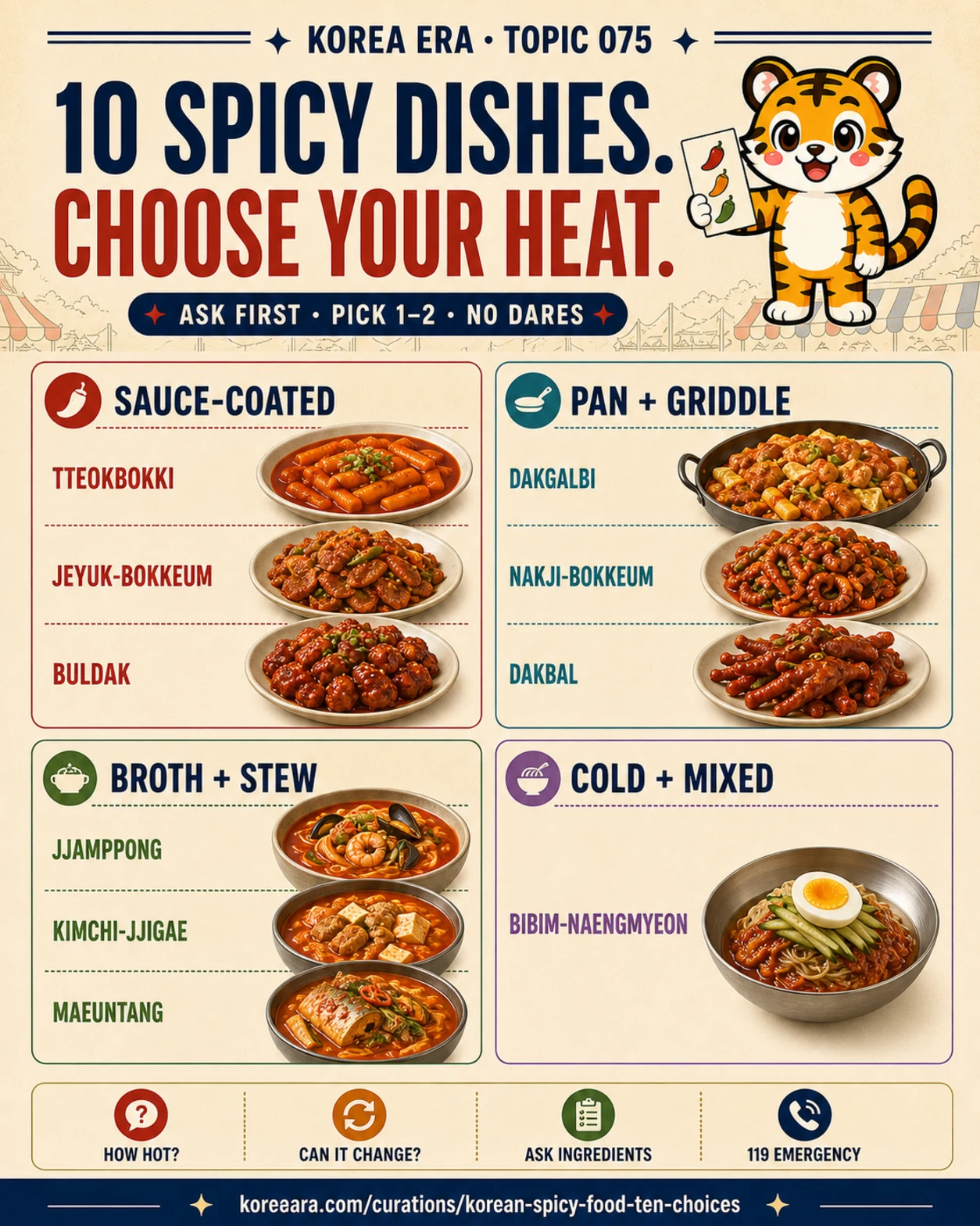
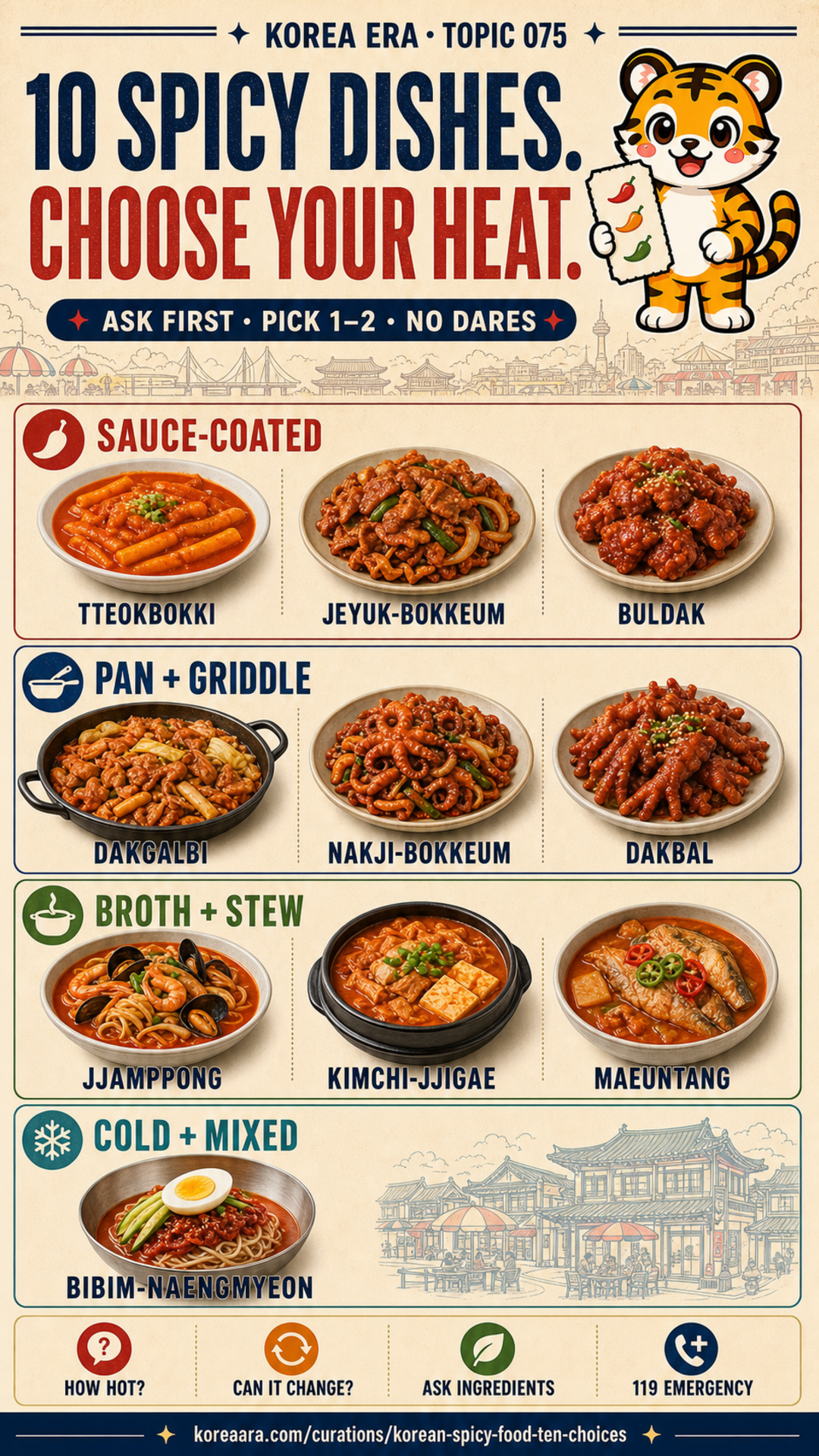
Korea Era Topic 075 spicy-food chooser with one tiger guide and ten Korean dishes grouped by sauce, pan, broth and mixed-noodle heat
Original Korea Era decision guide · the ten dishes are alternatives, and every restaurant's heat, recipe, portion and ability to adjust can differ.
TIME
10 spicy dishes · choose 1–2 at a real meal
BUDGET
Confirm heat, portion, minimum order and add-ons before cooking
BEST FOR
Chilli lovers · group meals · learning Korean heat vocabulary
MOVE
Pick one restaurant near the day's route; this is not a ten-stop crawl

THE FOOD EDIT

10 foods, each with a reason.

The groups help you choose. They are not a challenge to eat every dish or cross the city in order.
01

SAUCE-COATED · ASK BEFORE THE PAN

Three dishes where most of the heat is already mixed into the seasoning

A request for less heat can work only when the kitchen can change the batch or sauce ratio before cooking. Removing a garnish after plating does not remove the chilli in the sauce.
  1. 01

    Tteokbokki

    떡볶이

    Rice cakes simmer in a sweet-salty red sauce whose heat ranges from approachable to extreme. Ask which version is the standard and whether the sauce is made in one shared batch.

    Ask: 이거 많이 매워요? 1인분 돼요?Fish cake or seafood stock is common · soy and wheat can appear · a red colour is not a measured spice level
  2. 02

    Jeyuk-bokkeum

    제육볶음

    Thin pork and vegetables are stir-fried in a gochujang or chilli-based sauce and usually eaten with rice. Confirm whether one order is a solo plate or a shared pan.

    Ask whether rice is included and whether one portion is availablePork · soy, wheat, sesame and garlic are common · shared wok or griddle cross-contact
  3. 03

    Buldak

    불닭

    Chicken is cooked in a deliberately hot sauce; cheese or noodles may soften the experience but do not make the base mild. Brand-style 'extreme' labels are shop-specific, not a national scale.

    Confirm chicken cut, sharing size and optional cheese or noodlesChicken · soy/wheat, dairy and shared cooking surfaces possible · bones can remain in some versions
02

PAN + GRIDDLE · EVERYONE SHARING AGREES

Three shared dishes whose heat, protein and minimum order need separate confirmation

Do not order an extra-hot communal pan as a dare. Ask the group, choose the protein and portion, and confirm whether rice, noodles or cheese are optional finishes rather than included food.
  1. 01

    Dakgalbi

    닭갈비

    Chicken, cabbage and rice cakes cook together in a spicy sauce on a hot plate. The fried-rice finish is optional, and some restaurants require a minimum first order.

    Confirm portions, heat and add-ons before the pan startsChicken · soy/wheat in sauce · cheese contains dairy · shared pan stays hot after serving
  2. 02

    Nakji-bokkeum

    낙지볶음

    Small octopus is stir-fried in a concentrated red sauce and commonly mixed with rice. Distinguish plain nakji from nakgop or nakgopsae before accepting intestine or shrimp add-ins.

    Ask: 낙지만 들어가요? 1인분 돼요?Molluscan shellfish · beef intestine or shrimp appear in named variants · minimum portions can apply
  3. 03

    Dakbal

    닭발

    Chicken feet are coated in an assertive chilli sauce and served bone-in or boneless. 'Boneless' describes preparation, not necessarily a mild sauce or a small portion.

    Choose bone-in or boneless; confirm the sharing sizeChicken · sauce can contain soy/wheat · boneless pieces can still contain small fragments · shared grill or pan
03

BROTH + STEW · THE HEAT IS IN THE BOWL

Three red soups where ordering the chilli separately may not be possible

Broth is both the heat carrier and an ingredient risk. A request for less spice does not remove meat, fish, shellfish, anchovy stock or fermented seasoning already in the pot.
  1. 01

    Jjamppong

    짬뽕

    Wheat noodles arrive in a red broth commonly built with seafood and vegetables; pork can also be used. The broth may be batch-made, so ask whether a less-spicy version is genuinely available.

    Confirm seafood, pork and whether rice or noodles are includedWheat · shellfish, molluscs and fish likely · pork and soy possible · bowl and broth are extremely hot
  2. 02

    Kimchi-jjigae

    김치찌개

    Fermented kimchi cooks with ingredients such as pork, tuna or tofu in a bubbling stew. A red bowl may taste sour, salty and spicy at once, and the table's kimchi recipe matters.

    Ask which protein and whether rice is includedPork, tuna, anchovy stock or fish sauce are common · tofu/soy · shared stew or minimum portions can vary
  3. 03

    Maeuntang

    매운탕

    Fish and vegetables simmer in a chilli-based broth, often as a shared finish to a seafood meal. Confirm the fish, serving size and whether the stew is included or separately charged.

    Confirm fish, pot size, preparation charge and final totalFish · shellfish can share stock or utensils · soy and chilli paste possible · bones remain in the pot
04

COLD + MIXED · CONTROL THE SAUCE FIRST

One cold noodle bowl where sauce on the side can create a real decision point

Cold temperature does not mean mild. When the kitchen can serve the red sauce separately, add a little, mix completely and taste before adding more.
  1. 01

    Bibim-naengmyeon

    비빔냉면

    Chewy cold noodles are mixed with a concentrated red sauce rather than served in a full broth. Ask for sauce on the side before the bowl is assembled when the restaurant can do it.

    Ask: 양념 따로 가능해요?Beef broth or meat garnish possible · noodles may contain buckwheat and starch · egg, mustard, soy or wheat can appear

YOUR TASTE LIST

Keep a personal Korean food log.

Mark each food after you try it. Your list stays on this device.
Korea Era tiger mascot celebrating a completed route
0of 10 foods
0%

SAUCE-COATED · ASK BEFORE THE PAN

PAN + GRIDDLE · EVERYONE SHARING AGREES

BROTH + STEW · THE HEAT IS IN THE BOWL

COLD + MIXED · CONTROL THE SAUCE FIRST

No account needed. This taste list is saved only in this browser.

COST CONTROL

Know what changes the total.

Use these as planning envelopes, then confirm live tickets, transport and accommodation before paying.
01

First heat

One main dish

Start with the restaurant's standard version only after asking how hot it is. Extra-hot upgrades are optional, never the editorial goal.

02

Sharing consent

Every diner agrees

A communal pan, stew or large plate should match the least willing participant, not the loudest chilli fan.

03

Plain fallback

Confirm before relying

Rice, egg, dairy or side dishes may help you change the meal rhythm, but each has ingredients and none is an emergency treatment.

04

Portion + extras

Repeat the final total

Minimum portions, noodles, cheese, fried rice and seafood preparation can change both the bill and the amount of food.

TRIP BUDGETConfirm heat, portion, minimum order and add-ons before cookingActual prices vary by date, operator, distance and personal choices.

EDITOR’S NOTES

The choices that make this edit work.

NO UNIVERSAL SCALE

Ten choices, not a hottest-food ranking

A mild, original, hot or extreme label belongs to that restaurant or product. Compare the exact recipe and ask before ordering instead of assigning national chilli scores.

Restaurant version beats colour or viral reputation
ASK TWICE

How hot — and can it change?

First ask whether the dish is very spicy. Then ask whether less-spicy preparation is possible. A batch sauce or broth may make the honest answer no.

많이 매워요? · 덜 맵게 가능해요?
INGREDIENTS

Spice and allergy are different questions

Chilli preference does not answer pork, seafood, wheat, soy, sesame, nuts, dairy, egg, broth or shared-equipment risk. Ask both questions separately.

Heat choice ≠ allergen control
NO DARES

Stop when the experience stops being fun

Do not pressure another traveler into an extreme-spice order. Stop eating if someone feels unwell and seek appropriate help for severe symptoms rather than filming a reaction.

Consent first · 119 for a medical emergency

The poster is a visual memory aid. Use the structured route, live map and sources for decisions.

BEFORE YOU GO

What can still change

  • This is a ten-dish chooser, not a hottest-food ranking, eat-all challenge or one-day restaurant route. Choose one or two dishes that fit a real meal and the group sharing them.
  • Korea has no universal restaurant spice scale. Mild, original, hot and extreme are shop-specific labels, while the same dish name can use a different chilli, sauce ratio, broth and serving size.
  • Ask '이거 많이 매워요?' before ordering, then '덜 맵게 가능해요?' A pre-mixed tteokbokki batch, marinated meat or soup base may not be adjustable; choose another dish when the answer is no.
  • Sauce on the side is useful only when the kitchen can separate it before assembly. Removing a visible chilli, garnish or red sauce after cooking does not remove chilli already absorbed into broth, meat or rice cake.
  • Spice preference and food safety are different. Confirm meat, seafood, broth, wheat, soy, sesame, nuts, dairy and egg plus shared oil, grills, utensils and pans when allergies or dietary restrictions matter.
  • Tteokbokki can contain fish cake or seafood stock; jeyuk-bokkeum is pork; nakji-bokkeum is molluscan shellfish; jjamppong commonly contains seafood and can contain pork; maeuntang contains fish.
  • Communal dakgalbi, dakbal, nakji-bokkeum and maeuntang can have minimum portions. Confirm whether rice, noodles, cheese, fried rice, preparation or table charges are included before cooking starts.
  • Do not use plain rice, water, milk, egg or another food as a promised antidote or medical treatment. They have their own ingredients and may not be suitable for every traveler.
  • Do not turn an extreme-spice menu into a dare, reaction video or test of cultural authenticity. Every diner sharing the order should agree, and anyone can stop without embarrassment.
  • For breathing difficulty, faintness, severe swelling or another medical emergency, call 119. For non-emergency multilingual travel and communication help, contact 1330.

USEFUL KOREAN

6 phrases for this edit

이거 많이 매워요?
Is this very spicy?
덜 맵게 가능해요?
Can you make it less spicy?
양념 따로 가능해요?
Can the sauce be served separately?
보통맛으로 주세요.
Please make it the standard heat level.
1인분 돼요?
Can I order one portion?
고기나 해산물 육수가 들어가요?
Does it contain meat or seafood stock?

CHECKED SOURCES

The illustration is not the source.

Changing facts are linked to the public body or tourism operator responsible for them.
  1. VisitKorea · spicy-food guideKorea Tourism Organization overview of popular spicy dishes and dish-level variation.Open official source ↗
  2. VisitKorea · K-Food HighlightsOfficial national food discovery desk for current dish and regional context.Open official source ↗
  3. VisitKorea · bunsik and street foodOfficial context for tteokbokki and ordering street-food portions.Open official source ↗
  4. VisitKorea · tteokbokki food recordOfficial ingredient and red-versus-nonspicy variation context for tteokbokki.Open official source ↗
  5. Visit Busan · nakji-bokkeum exampleOfficial city example separating stir-fried octopus from named mixed-protein variants and hot pot.Open official source ↗
  6. Food Safety Korea · allergen informationMFDS-backed allergen reference; spice preference is not an allergen assessment.Open official source ↗
  7. Korea Travel Hotline 1330Official multilingual non-emergency travel-help channel for ordering and communication questions.Open official source ↗
  8. VisitKorea · emergency guideOfficial 112, 119 and medical-help orientation for foreign travelers.Open official source ↗

NEXT EDIT

Choose another kind of day.

3 nights · 4 daysSeoul in 3 nights and 4 real days3 nights · 4 calendar daysCity dayOne first day in Seoul without crossing the city twice1 day · suggested 09:00–20:00Budget dayA full Seoul day for ₩50,0001 day · 08:30–20:30